Media contact
Do you have questions about our refuelling station network, would you like to learn more about station operation, or are you interested in the topic hydrogen in mobility? Do you need pictures or video material for your publication? Contact us.
Your contact person

Press Releases
28.09.2026
H2IA moves “Connecting the Dots” into action as hydrogen truck deployment gains momentum at IAA Transportation
Berlin, 28 September 2026 | The hydrogen infrastructure alliance (H2IA), an international alliance of hydrogen refuelling station operators, is actively fostering concrete conversations with various OEMs about the rollout of hydrogen trucks in Europe, after a successful kick-off since the creation of the alliance.
By connecting OEM rollout plans with the existing and planned refuelling networks of its members, H2IA aims to accelerate hydrogen mobility through better alignment of vehicles, infrastructure, locations and deployment timelines at European scale. The objective is straightforward: hydrogen trucks need access to reliable refuelling infrastructure, while stations need sufficient vehicle volumes to operate economically. H2IA’s “Connecting the Dots” approach is designed to help bring both sides together.
Visible results
The energy transition is no longer a discussion between ‘left’ or ‘right’. Besides climate change, energy security—from geopolitics to grid congestion—and a ‘competitive price at the pump’ are the key drivers for hydrogen in addition to battery-electric. The operators from the H2IA commercially deploy trucks around their stations network.
Acceleration
The IAA Transportation in Hanover featured multiple new announcements about hydrogen. Companies such as MAN and Hyundai already deploy hydrogen trucks in commercial fleets. Announcements surrounding the IAA Transportation show that Scania, Iveco, Volvo and Daimler are now also entering the hydrogen truck market with new vehicle models, pilots and/or preseries.
The increasing presence of international manufacturers at the IAA Transportation, including Chinese such as Dongfeng and Foton, confirms that hydrogen trucking is becoming a global market opportunity. Coordinated deployment of vehicles and infrastructure will be important for Europe to maintain a competitive position.
For H2IA, the next step is therefore not simply to develop more stations or wait for additional vehicles to enter the market. It is to connect the two deployment strategies.
Through direct dialogue with OEMs, H2IA seeks to identify where expected vehicle volumes can be matched with existing or planned refuelling capacity, where infrastructure gaps remain, and where cross-border hydrogen mobility corridors can progressively emerge. More vehicle models, combined with greater network coverage and coordinated deployment, can generate the scale required to improve station utilization and strengthen the business case for both hydrogen trucks and infrastructure.
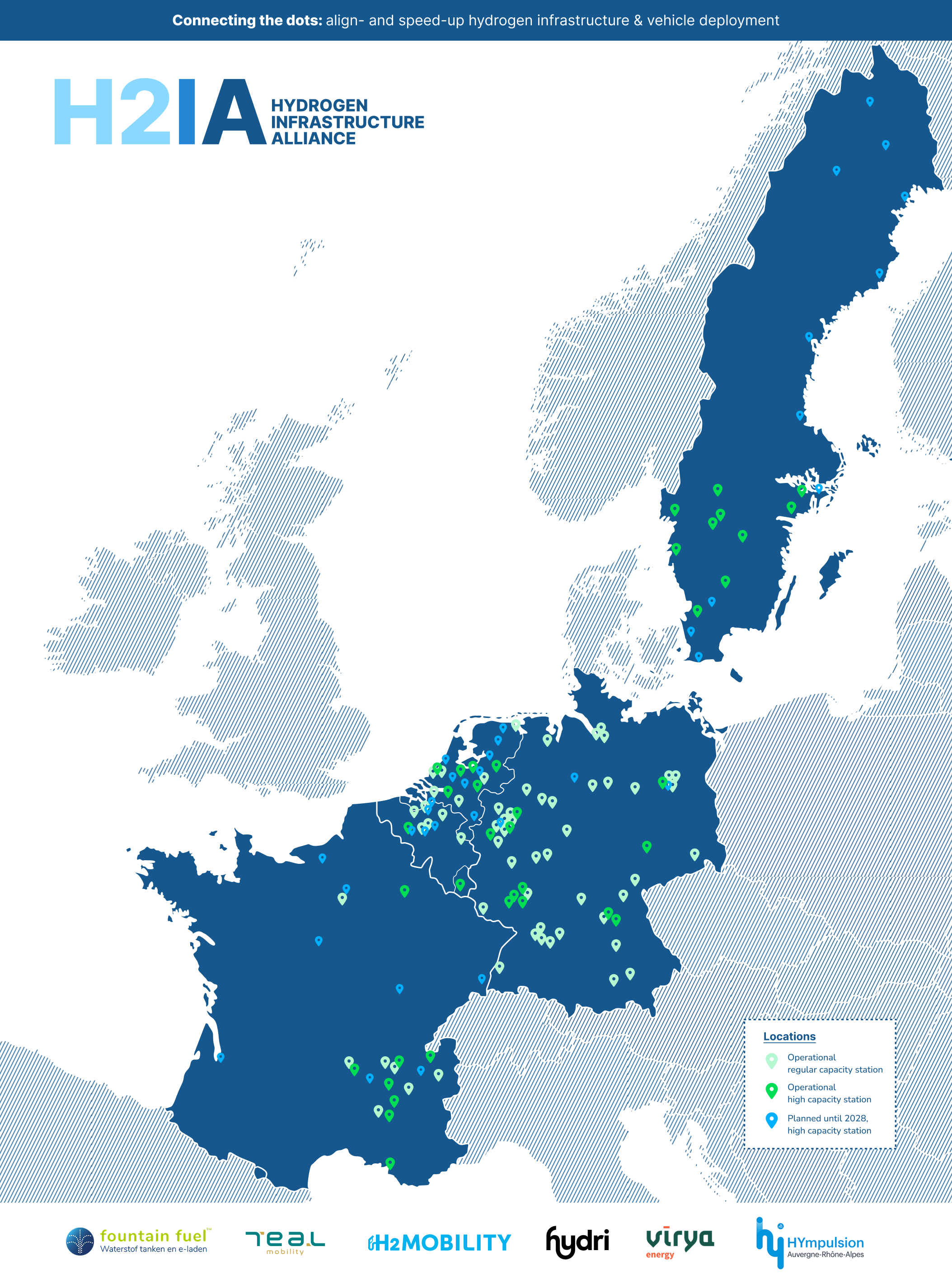 The Hydrogen Infrastructure Alliance
 (H2IA) is a collaboration between six ambitious and leading European operators of hydrogen refuelling stations, who want to accelerate the rollout of hydrogen mobility across Europe. The alliance stresses the importance for the availability of vehicle models and the opportunity to coordinate infrastructure development with vehicle deployment. The goal is to align infrastructure and vehicle commitments by 2028.
The alliance includes prominent members from various European member states—Hydri, TEAL-Mobility, Fountain Fuel, H2 MOBILITY, Virya Energy and HYmpulsion. These companies jointly operate over 90 hydrogen refuelling stations (HRS) for light- and heavy-duty fleets, with 39 more large-scale stations planned which will be enough to refuel over 1,800 trucks daily. The alliance has initiated conversations with leading vehicle manufacturers about accelerating hydrogen mobility.
Through its “Connecting the Dots” strategy, H2IA is engaging with vehicle manufacturers and other market stakeholders to translate hydrogen truck deployment plans into concrete opportunities around existing and planned refuelling infrastructure. The ambition is to help create an increasingly connected European network in which hydrogen trucks can operate across regions and borders with reliable access to refuelling infrastructure.
The Hydrogen Infrastructure Alliance
The Hydrogen Infrastructure Alliance (H2IA) is a collaboration between six ambitious and leading European operators of hydrogen refuelling stations, who want to accelerate the rollout of hydrogen mobility across Europe. The alliance stresses the importance for the availability of vehicle models and the opportunity to coordinate infrastructure development with vehicle deployment. The goal is to align infrastructure and vehicle commitments by 2028.
The alliance includes prominent members from various European member states—Hydri, TEAL-Mobility, Fountain Fuel, H2 MOBILITY, Virya Energy and HYmpulsion. These companies jointly operate over 90 hydrogen refuelling stations (HRS) for light- and heavy-duty fleets, with 39 more large-scale stations planned which will be enough to refuel over 1,800 trucks daily. The alliance has initiated conversations with leading vehicle manufacturers about accelerating hydrogen mobility.
Through its “Connecting the Dots” strategy, H2IA is engaging with vehicle manufacturers and other market stakeholders to translate hydrogen truck deployment plans into concrete opportunities around existing and planned refuelling infrastructure. The ambition is to help create an increasingly connected European network in which hydrogen trucks can operate across regions and borders with reliable access to refuelling infrastructure.
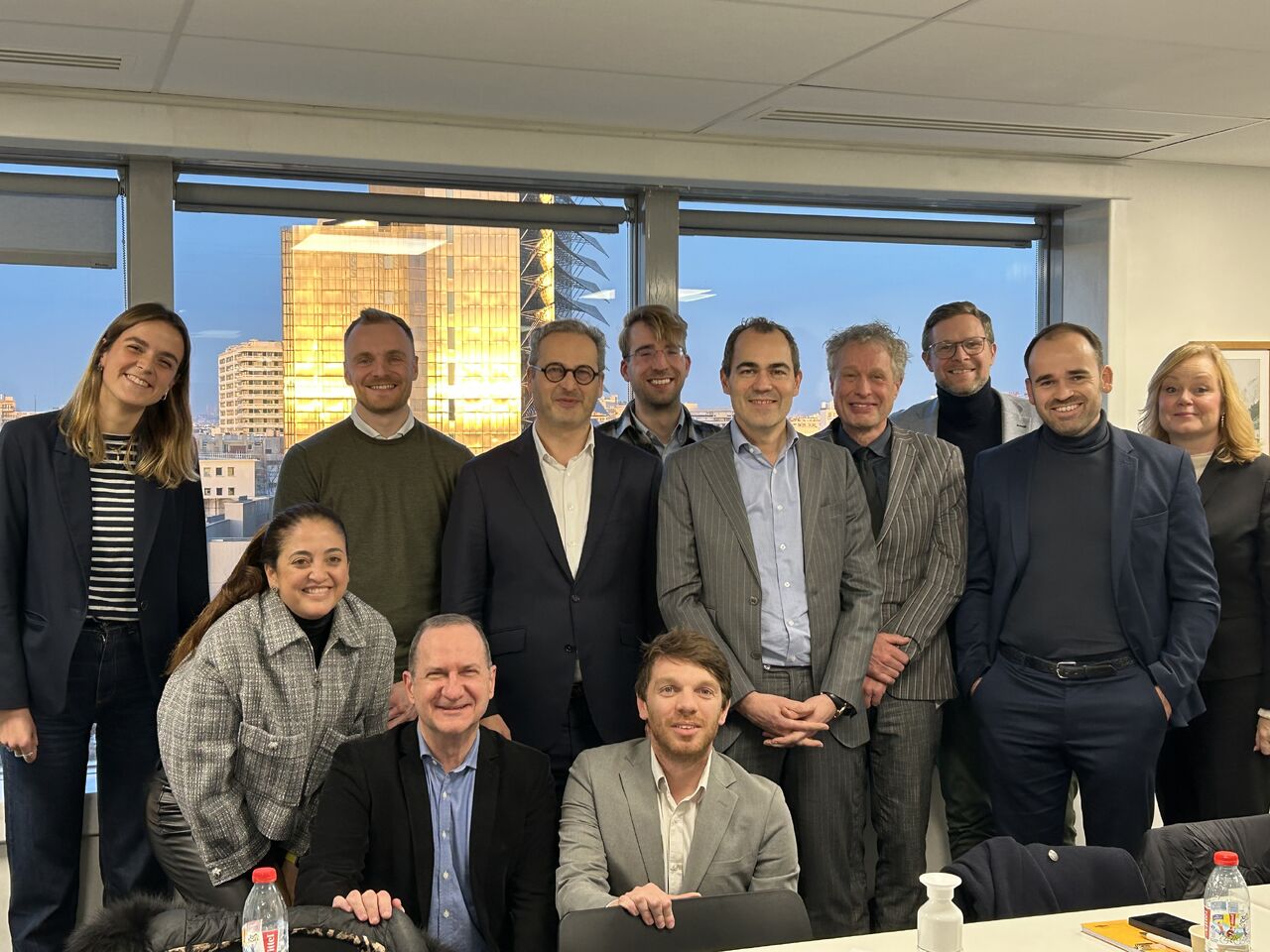 Watch introduction and member-vision statements on YouTube.
Media contact Germany:
Daniela Dietz, Head of Communications, H2 MOBILITY
presse@h2-mobility.de
Watch introduction and member-vision statements on YouTube.
Media contact Germany:
Daniela Dietz, Head of Communications, H2 MOBILITY
presse@h2-mobility.de
The Hydrogen Infrastructure Alliance
The Hydrogen Infrastructure Alliance (H2IA) is a collaboration between six ambitious and leading European operators of hydrogen refuelling stations, who want to accelerate the rollout of hydrogen mobility across Europe. The alliance stresses the importance for the availability of vehicle models and the opportunity to coordinate infrastructure development with vehicle deployment. The goal is to align infrastructure and vehicle commitments by 2028.
The alliance includes prominent members from various European member states—Hydri, TEAL-Mobility, Fountain Fuel, H2 MOBILITY, Virya Energy and HYmpulsion. These companies jointly operate over 90 hydrogen refuelling stations (HRS) for light- and heavy-duty fleets, with 39 more large-scale stations planned which will be enough to refuel over 1,800 trucks daily. The alliance has initiated conversations with leading vehicle manufacturers about accelerating hydrogen mobility.
Through its “Connecting the Dots” strategy, H2IA is engaging with vehicle manufacturers and other market stakeholders to translate hydrogen truck deployment plans into concrete opportunities around existing and planned refuelling infrastructure. The ambition is to help create an increasingly connected European network in which hydrogen trucks can operate across regions and borders with reliable access to refuelling infrastructure.
Watch introduction and member-vision statements on YouTube.
Media contact Germany:
Daniela Dietz, Head of Communications, H2 MOBILITY
presse@h2-mobility.de
25.09.2026
Second price reduction in 2026: H2 MOBILITY lowers hydrogen prices at 15 additional refuelling stations
 Berlin, 25 September 2026 | H2 MOBILITY will lower hydrogen prices at 15 additional locations in Germany from 1 October 2026. At hydrogen refuelling stations from Bayreuth to Wesseling, the gross price per kilogram of hydrogen will be reduced by between twelve and 16 per cent. As a result, even more customers will benefit from the effects of GHG quota trading.
The price reduction applies to stations that were originally built primarily for hydrogen-powered passenger cars (FCEV). In recent years, H2 MOBILITY has technically upgraded these locations for use by buses and trucks. By supplying these stations with green hydrogen* in combination with revenues generated from saved greenhouse gas emissions through GHG quota trading, H2 MOBILITY is able to pass on a positive price signal to its customers.
The price reduction will take effect at the following H2 MOBILITY stations on 1 October: Bayreuth, Dueren, Duesseldorf-Oerschbachstrasse, Erlangen, Frechen, Fuerth, Herten, Cologne/Bonn Airport, Leverkusen, Munich, Saarbruecken, Sindelfingen, Stuttgart Airport, Weiterstadt and Wesseling.
Second step following the first price reduction in June
On 1 June 2026, H2 MOBILITY had already reduced hydrogen prices by around ten per cent at five new, high-capacity stations in Mannheim, Heidelberg, Frankenthal, Ludwigshafen and Duesseldorf-Hoeherweg. At these locations, the use of green hydrogen and the revenue opportunities offered by GHG quota trading, alongside economies of scale, had been key factors in enabling the price reduction.
In a market environment in which prices have predominantly risen in recent years, the price reductions mark an important development. They demonstrate that regulatory instruments such as GHG quota trading improve the economic viability of green hydrogen by enabling the resulting benefits to be passed on along the value chain.
Martin Jüngel, Managing Director and CFO, H2 MOBILITY: “Following the first price reduction in June, the use of green hydrogen in combination with GHG quota trading now enables us to lower prices at 15 additional stations, thereby increasing the attractiveness of green hydrogen in transport. It is important that the impact reaches the market and that transport operators and the logistics sector, in particular, benefit from lower operating costs.”
GHG quota trading strengthens hydrogen mobility
Greenhouse gas quota trading, known as GHG quota trading, requires companies in the transport sector to gradually reduce the CO₂ emissions associated with their fuels. Companies that continue to use fossil fuels must meet corresponding reduction obligations or make financial compensation payments.
For hydrogen mobility, this instrument provides important economic and environmental advantages. As green hydrogen contributes to reducing greenhouse gas emissions, the resulting emissions savings can be marketed. This improves the economic conditions for the use of green hydrogen.
*Hydrogen is considered green or renewable if it complies with the requirements for renewable fuels of non-biological origin (RFNBO) under the EU Renewable Energy Directive (RED III), i. e. it is produced from renewable electricity via electrolysis and meets additional regulatory requirements regarding the origin of the electricity.
Contact:
Daniela Dietz, presse@h2-mobility.de
Image copyright: H2 MOBILITY
Berlin, 25 September 2026 | H2 MOBILITY will lower hydrogen prices at 15 additional locations in Germany from 1 October 2026. At hydrogen refuelling stations from Bayreuth to Wesseling, the gross price per kilogram of hydrogen will be reduced by between twelve and 16 per cent. As a result, even more customers will benefit from the effects of GHG quota trading.
The price reduction applies to stations that were originally built primarily for hydrogen-powered passenger cars (FCEV). In recent years, H2 MOBILITY has technically upgraded these locations for use by buses and trucks. By supplying these stations with green hydrogen* in combination with revenues generated from saved greenhouse gas emissions through GHG quota trading, H2 MOBILITY is able to pass on a positive price signal to its customers.
The price reduction will take effect at the following H2 MOBILITY stations on 1 October: Bayreuth, Dueren, Duesseldorf-Oerschbachstrasse, Erlangen, Frechen, Fuerth, Herten, Cologne/Bonn Airport, Leverkusen, Munich, Saarbruecken, Sindelfingen, Stuttgart Airport, Weiterstadt and Wesseling.
Second step following the first price reduction in June
On 1 June 2026, H2 MOBILITY had already reduced hydrogen prices by around ten per cent at five new, high-capacity stations in Mannheim, Heidelberg, Frankenthal, Ludwigshafen and Duesseldorf-Hoeherweg. At these locations, the use of green hydrogen and the revenue opportunities offered by GHG quota trading, alongside economies of scale, had been key factors in enabling the price reduction.
In a market environment in which prices have predominantly risen in recent years, the price reductions mark an important development. They demonstrate that regulatory instruments such as GHG quota trading improve the economic viability of green hydrogen by enabling the resulting benefits to be passed on along the value chain.
Martin Jüngel, Managing Director and CFO, H2 MOBILITY: “Following the first price reduction in June, the use of green hydrogen in combination with GHG quota trading now enables us to lower prices at 15 additional stations, thereby increasing the attractiveness of green hydrogen in transport. It is important that the impact reaches the market and that transport operators and the logistics sector, in particular, benefit from lower operating costs.”
GHG quota trading strengthens hydrogen mobility
Greenhouse gas quota trading, known as GHG quota trading, requires companies in the transport sector to gradually reduce the CO₂ emissions associated with their fuels. Companies that continue to use fossil fuels must meet corresponding reduction obligations or make financial compensation payments.
For hydrogen mobility, this instrument provides important economic and environmental advantages. As green hydrogen contributes to reducing greenhouse gas emissions, the resulting emissions savings can be marketed. This improves the economic conditions for the use of green hydrogen.
*Hydrogen is considered green or renewable if it complies with the requirements for renewable fuels of non-biological origin (RFNBO) under the EU Renewable Energy Directive (RED III), i. e. it is produced from renewable electricity via electrolysis and meets additional regulatory requirements regarding the origin of the electricity.
Contact:
Daniela Dietz, presse@h2-mobility.de
Image copyright: H2 MOBILITY
15.09.2026
IAA Transportation premiere: ‘Night of Hydrogen’ honors companies for pioneering use of hydrogen in logistics
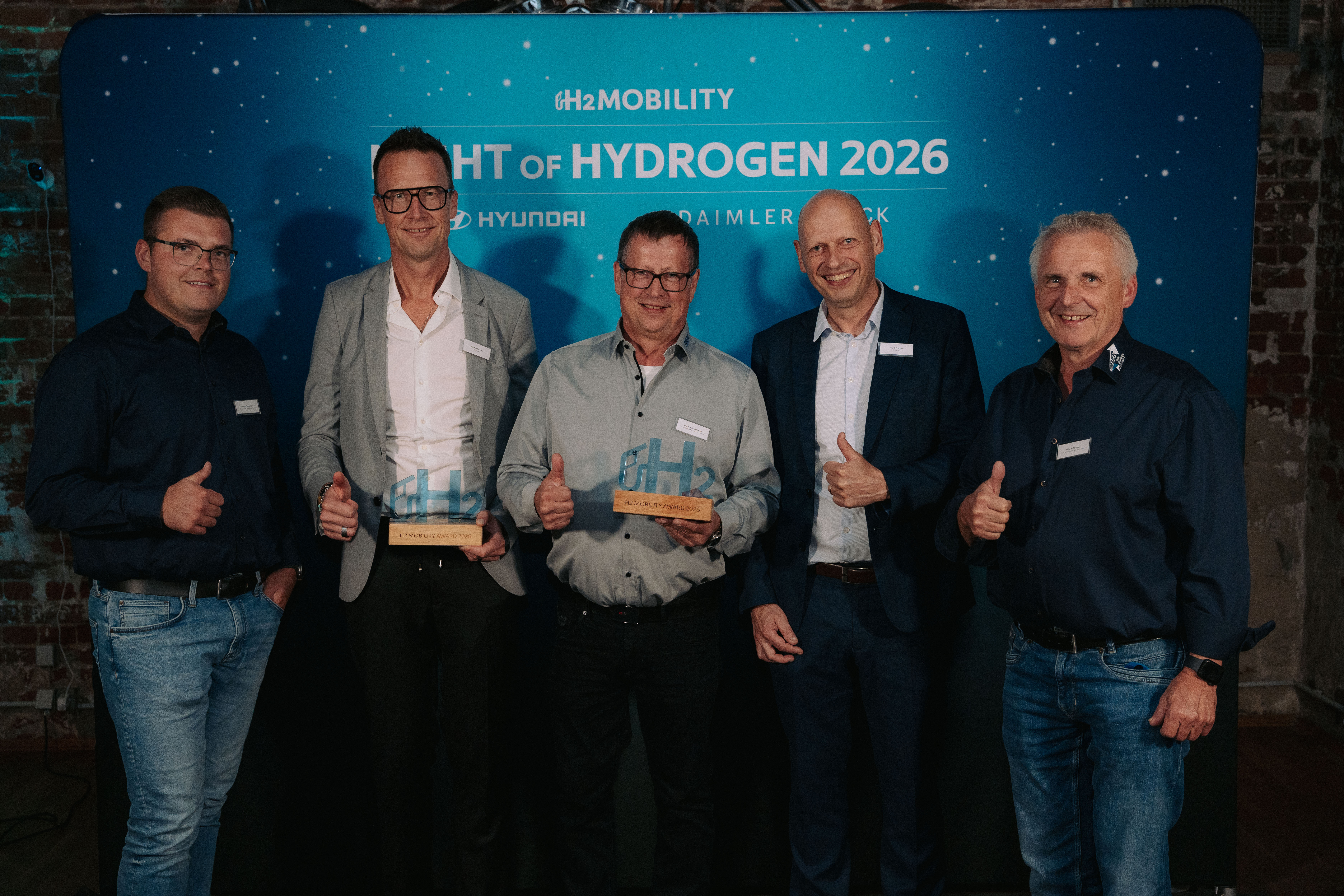 Hannover, 15 September 2026 | On the eve of IAA Transportation, H2 MOBILITY’s event for the hydrogen mobility industry brought together more than 90 guests from the commercial vehicle and logistics sectors. Supported by Daimler Truck and Hyundai, the event focused on the industry’s determination to drive the market ramp-up of hydrogen-powered trucks and showcased real-world applications by logistics companies already using hydrogen in their fleets.
Companies from across the commercial vehicle and logistics industries came together at the Night of Hydrogen to champion the continued expansion of hydrogen-powered road freight. A highlight of the evening was the presentation of the H2 MOBILITY Awards to companies already demonstrating the viability of hydrogen in demanding day-to-day logistics operations.
The ‘Hydrogen Power User’ H2 MOBILITY Award went to WTK Stratmann, a North Rhine-Westphalia-based company specialising in silo tanker and container transport. The company runs a MAN hTGX in two shifts, transporting gases and chemicals and covering more than 800 kilometres per day. In a single day, the truck took on 86 kilograms of hydrogen – a record for a single vehicle across the H2 MOBILITY refuelling network.
The ‘Hydrogen Pioneer’ H2 MOBILITY Award went to vehicle body manufacturer EWERS Fahrzeugbau and Gettrans, a logistics company specialising in beverage transport, for jointly developing a beverage logistics body specifically designed for the Hyundai XCIENT Fuel Cell. The first vehicle of its kind anywhere in the world, it combines hydrogen propulsion with a body tailored to the specific demands of beverage logistics. Its swing-wall body allows fast side loading and unloading while offering certified load securing and a high payload capacity. The vehicle demonstrates that hydrogen power is increasingly viable even for demanding distribution and logistics operations. The tandem truck-and-trailer combination has space for 36 Euro pallets and can operate in two shifts on regional routes. During the Night of Hydrogen, Hyundai handed over the vehicle to Gettrans Managing Director Steffen Richter.
Vehicle manufacturers reaffirm commitment to hydrogen in heavy-duty transport
The Night of Hydrogen vehicle showcase featured everything from hydrogen vehicles already in daily operation to the next generation of fuel-cell electric commercial vehicles and passenger cars. Among them was an H2 tractor unit from Volvo Trucks, making its German debut at IAA Transportation. Together with H2 trucks already in service – including the Mercedes-Benz NextGenH2, Hyundai XCIENT Fuel Cell, MAN hTGX, and KEYOU BRAD – the exhibit showcased the growing range of hydrogen-powered options on the commercial vehicle market. Also featured in the vehicle presentation was the Toyota Hilux Fuel Cell, classified in the N1 vehicle category.
Just in time for IAA Transportation: New hydrogen refuelling station opens at Hannover-Langenhagen Airport
Just hours before the Night of Hydrogen began, H2 MOBILITY’s new hydrogen refuelling station for commercial vehicles at Hannover-Langenhagen Airport officially began trial operations. Located close to the A2 and A7 motorways, the station strengthens the hydrogen refuelling network at one of northern Germany’s most important logistics hubs. It supplies trucks, buses, and passenger cars with RFNBO-compliant green hydrogen and meets the requirements of the EU’s Alternative Fuels Infrastructure Regulation (AFIR).
Martin Jüngel, Managing Director and CFO, H2 MOBILITY: “The Night of Hydrogen shows just how strongly the electrification of heavy-duty transport has shifted towards hydrogen over the past few years. Hydrogen-powered trucks and buses are already on the road, operators are gaining valuable real-world experience, and high-capacity refuelling infrastructure continues to expand. New vehicle models, specialised logistics solutions, and the projects we are recognising tonight all show that we have moved well beyond the demonstration stage. We are now moving from successful early applications to commercialisation on a much broader scale.”
Volker Hasenberg, Head of International Hydrogen Strategy, Daimler Truck: “Hydrogen has an important role to play in reducing transport emissions, particularly in certain heavy-duty applications. But to realise that potential, vehicles, infrastructure, and hydrogen supply need to develop in step. Getting all three right is essential if hydrogen solutions are to work for our customers at scale.”
Mark Freymueller, CEO, Hyundai Energy & Hydrogen Europe: “Hyundai Motor Group and its 74 subsidiaries have set themselves the goal of achieving net-zero emissions by 2045. Hydrogen will be central to achieving that goal, and our commitment to the technology extends far beyond mobility. We can already see in commercial vehicles what hydrogen technology can contribute to decarbonising transport. That’s why we need the entire value chain working together if we are going to take hydrogen applications to scale.”
About H2 MOBILITY
H2 MOBILITY makes hydrogen a practical option for everyday transport. As Europe’s largest operator of hydrogen refuelling stations, H2 MOBILITY develops, builds, and operates hydrogen refuelling solutions for all vehicle classes. Through its RETAIL, SERVICES, and FLEET business units, the company provides integrated solutions across the entire hydrogen value chain. These include the operation of hydrogen refuelling stations, technical and operational services for hydrogen and other gas installations, EPC projects, and digital services for climate-friendly fleet operations. By 2028, H2 MOBILITY will supply all of its own stations exclusively with green hydrogen certified as RFNBO-compliant under EU requirements.
Contact:
Daniela Dietz, presse@h2-mobility.de
Image copyright: H2 MOBILTIY
Hannover, 15 September 2026 | On the eve of IAA Transportation, H2 MOBILITY’s event for the hydrogen mobility industry brought together more than 90 guests from the commercial vehicle and logistics sectors. Supported by Daimler Truck and Hyundai, the event focused on the industry’s determination to drive the market ramp-up of hydrogen-powered trucks and showcased real-world applications by logistics companies already using hydrogen in their fleets.
Companies from across the commercial vehicle and logistics industries came together at the Night of Hydrogen to champion the continued expansion of hydrogen-powered road freight. A highlight of the evening was the presentation of the H2 MOBILITY Awards to companies already demonstrating the viability of hydrogen in demanding day-to-day logistics operations.
The ‘Hydrogen Power User’ H2 MOBILITY Award went to WTK Stratmann, a North Rhine-Westphalia-based company specialising in silo tanker and container transport. The company runs a MAN hTGX in two shifts, transporting gases and chemicals and covering more than 800 kilometres per day. In a single day, the truck took on 86 kilograms of hydrogen – a record for a single vehicle across the H2 MOBILITY refuelling network.
The ‘Hydrogen Pioneer’ H2 MOBILITY Award went to vehicle body manufacturer EWERS Fahrzeugbau and Gettrans, a logistics company specialising in beverage transport, for jointly developing a beverage logistics body specifically designed for the Hyundai XCIENT Fuel Cell. The first vehicle of its kind anywhere in the world, it combines hydrogen propulsion with a body tailored to the specific demands of beverage logistics. Its swing-wall body allows fast side loading and unloading while offering certified load securing and a high payload capacity. The vehicle demonstrates that hydrogen power is increasingly viable even for demanding distribution and logistics operations. The tandem truck-and-trailer combination has space for 36 Euro pallets and can operate in two shifts on regional routes. During the Night of Hydrogen, Hyundai handed over the vehicle to Gettrans Managing Director Steffen Richter.
Vehicle manufacturers reaffirm commitment to hydrogen in heavy-duty transport
The Night of Hydrogen vehicle showcase featured everything from hydrogen vehicles already in daily operation to the next generation of fuel-cell electric commercial vehicles and passenger cars. Among them was an H2 tractor unit from Volvo Trucks, making its German debut at IAA Transportation. Together with H2 trucks already in service – including the Mercedes-Benz NextGenH2, Hyundai XCIENT Fuel Cell, MAN hTGX, and KEYOU BRAD – the exhibit showcased the growing range of hydrogen-powered options on the commercial vehicle market. Also featured in the vehicle presentation was the Toyota Hilux Fuel Cell, classified in the N1 vehicle category.
Just in time for IAA Transportation: New hydrogen refuelling station opens at Hannover-Langenhagen Airport
Just hours before the Night of Hydrogen began, H2 MOBILITY’s new hydrogen refuelling station for commercial vehicles at Hannover-Langenhagen Airport officially began trial operations. Located close to the A2 and A7 motorways, the station strengthens the hydrogen refuelling network at one of northern Germany’s most important logistics hubs. It supplies trucks, buses, and passenger cars with RFNBO-compliant green hydrogen and meets the requirements of the EU’s Alternative Fuels Infrastructure Regulation (AFIR).
Martin Jüngel, Managing Director and CFO, H2 MOBILITY: “The Night of Hydrogen shows just how strongly the electrification of heavy-duty transport has shifted towards hydrogen over the past few years. Hydrogen-powered trucks and buses are already on the road, operators are gaining valuable real-world experience, and high-capacity refuelling infrastructure continues to expand. New vehicle models, specialised logistics solutions, and the projects we are recognising tonight all show that we have moved well beyond the demonstration stage. We are now moving from successful early applications to commercialisation on a much broader scale.”
Volker Hasenberg, Head of International Hydrogen Strategy, Daimler Truck: “Hydrogen has an important role to play in reducing transport emissions, particularly in certain heavy-duty applications. But to realise that potential, vehicles, infrastructure, and hydrogen supply need to develop in step. Getting all three right is essential if hydrogen solutions are to work for our customers at scale.”
Mark Freymueller, CEO, Hyundai Energy & Hydrogen Europe: “Hyundai Motor Group and its 74 subsidiaries have set themselves the goal of achieving net-zero emissions by 2045. Hydrogen will be central to achieving that goal, and our commitment to the technology extends far beyond mobility. We can already see in commercial vehicles what hydrogen technology can contribute to decarbonising transport. That’s why we need the entire value chain working together if we are going to take hydrogen applications to scale.”
About H2 MOBILITY
H2 MOBILITY makes hydrogen a practical option for everyday transport. As Europe’s largest operator of hydrogen refuelling stations, H2 MOBILITY develops, builds, and operates hydrogen refuelling solutions for all vehicle classes. Through its RETAIL, SERVICES, and FLEET business units, the company provides integrated solutions across the entire hydrogen value chain. These include the operation of hydrogen refuelling stations, technical and operational services for hydrogen and other gas installations, EPC projects, and digital services for climate-friendly fleet operations. By 2028, H2 MOBILITY will supply all of its own stations exclusively with green hydrogen certified as RFNBO-compliant under EU requirements.
Contact:
Daniela Dietz, presse@h2-mobility.de
Image copyright: H2 MOBILTIY
15.09.2026
Operations get underway: Hydrogen refuelling station for logistics at Hannover-Langenhagen Airport
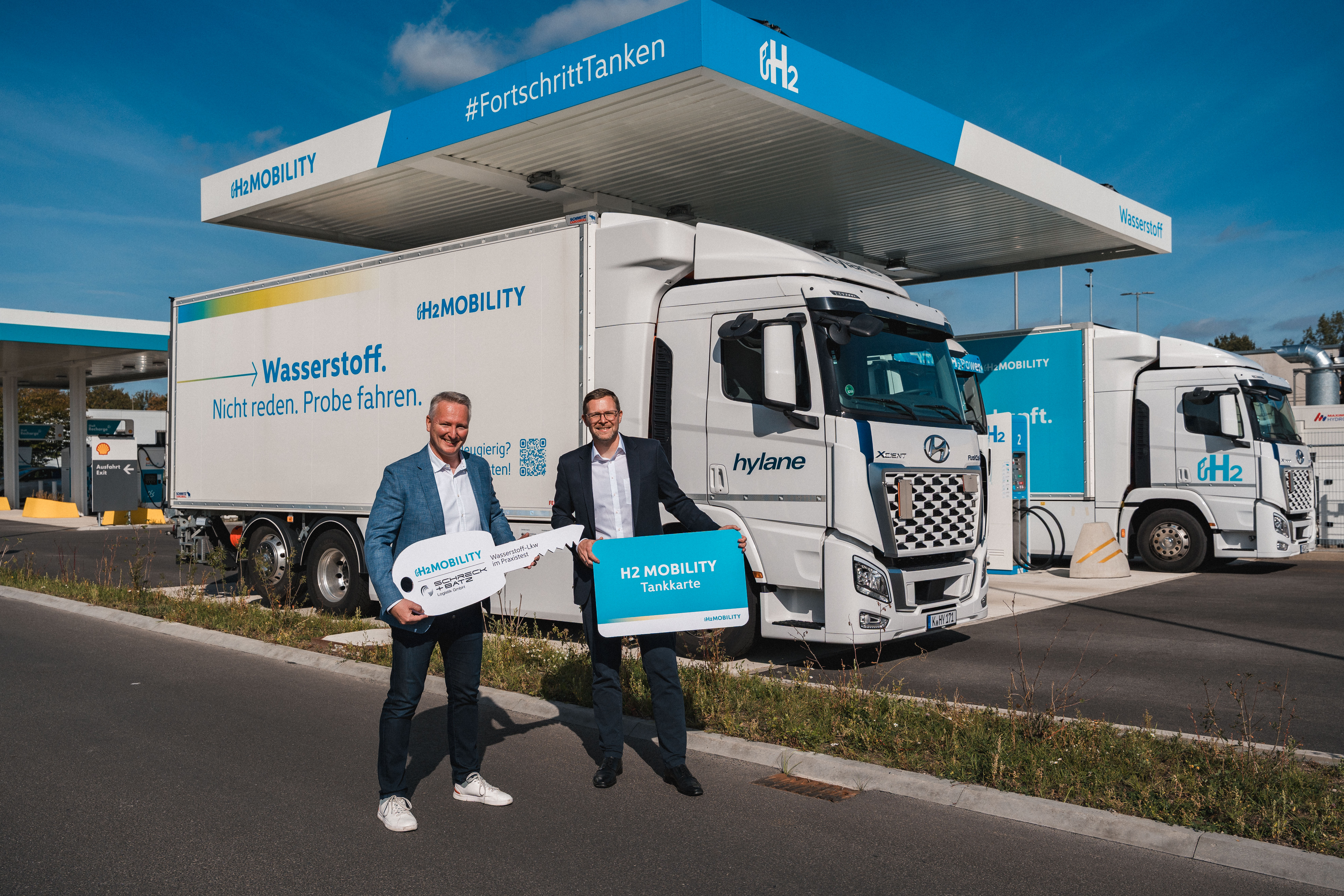 Langenhagen, 14 September 2026 | H2 MOBILITY’s new hydrogen refuelling station at Hannover-Langenhagen Airport is starting trial operations in time for IAA Transportation, which takes place in the Lower Saxony state capital from 15 to 20 September. Commercial vehicles and passenger cars can now refuel at the station. A Langenhagen-based logistics company is putting the climate-friendly fuel to the test in real-world operations.
Together with logistics companies that already use hydrogen in their fleets, H2 MOBILITY officially launched trial operations at the station in the Hannover Airport service area today. Langenhagen-based Schreck + Batz Logistik also took delivery of a hydrogen truck for testing.
Mirko Heuer, Mayor of Langenhagen: “The multi-fuel service area that opened earlier this year is an excellent fit for Langenhagen: it is technology-neutral, conveniently located, and offers a range of solutions for more climate-friendly mobility. The new hydrogen refuelling station adds another important element to that offering. In a location like Langenhagen, with its airport, motorways, and high traffic volumes, we need to work towards making mobility and freight transport as low-emission as possible. I’m especially pleased to see Schreck + Batz Logistik, a local Langenhagen company, testing the technology directly in its day-to-day operations. This shows in very practical terms how new drive technologies can help transform mobility.”
Hannover logistics region expands its hydrogen infrastructure
The new hydrogen refuelling station is located in the immediate vicinity of Hannover-Langenhagen Airport and the A2 and A7 motorways. This puts it at one of northern Germany’s most important transport hubs, on the European North Sea–Baltic TEN-T corridor, giving both regional fleets and long-distance freight transport access to public hydrogen refuelling infrastructure.
Jessica Porada, Head of Economic Development and Real Estate at the City of Langenhagen: “Efficient, future-ready infrastructure is an important factor in making Langenhagen an attractive location for our businesses. The hydrogen refuelling station gives businesses in Langenhagen another opportunity to use alternative drive technologies under real-world conditions. This makes it easier for local companies to adopt new technologies and gain practical experience. For us, this is exactly what effective economic development should do: create the right conditions for local businesses while supporting the transition to a more sustainable economy.”
RFNBO-compliant green hydrogen
The station has two dispensers for refuelling trucks, buses, and passenger cars and is supplied with green hydrogen that meets the EU criteria for RFNBOs (“Renewable Fuels of Non-Biological Origin”). This means that the electricity used for water electrolysis comes exclusively from renewable sources. RFNBO hydrogen helps reduce greenhouse gas emissions and generates revenue through GHG quota trading, which is key to making green hydrogen competitive in the transport sector. Depending on the vehicle, a complete refuelling process at 350, 500, or 700 bar takes around five to ten minutes.
The station meets the requirements of the EU’s Alternative Fuels Infrastructure Regulation (AFIR) governing the rollout of alternative fuels infrastructure across Europe. In logistics, hydrogen is an important low-emission fuel for applications requiring long ranges and short turnaround times, as well as for depot locations with limited grid capacity.
Martin Jüngel, Managing Director and CFO, H2 MOBILITY: “IAA Transportation is showing just how much more important hydrogen has become to the decarbonisation of road freight over the past two years. The entire market, from vehicle manufacturers to energy producers, is working hard to ramp up hydrogen-powered e-mobility. This is particularly evident in the new models and technologies being presented at the show. With the new station at Hannover-Langenhagen Airport, we are creating the conditions companies need to use hydrogen-powered vehicles – whether with hydrogen combustion engines or fuel-cell electric drives – in their day-to-day operations both within the region and beyond.”
The hydrogen refuelling station is receiving up to €5.831 million in funding from the Federal Ministry of Transport (BMV) under the market activation funding guidelines of Phase 2 of the National Innovation Programme for Hydrogen and Fuel Cell Technology (NIP2). Funding for the project is also being provided through the German Recovery and Resilience Plan (DARP) under the EU’s Recovery and Resilience Facility (RRF) as part of the NextGenerationEU programme. The funding programme is coordinated by NOW GmbH and implemented by Project Management Jülich (PtJ).
Johannes Daum, Spokesperson and Head of Mobility Technologies, NOW GmbH: “The new hydrogen refuelling station at Hannover-Langenhagen Airport shows how federal funding can enable real-world applications. Where infrastructure is built and put directly to use by companies, valuable practical experience is gained that helps drive market ramp-up. Locations like this can become hubs where viable hydrogen value chains can develop, while also making an important contribution to meeting European AFIR requirements.”
Hannover-Langenhagen Airport as a mobility hub
The hydrogen refuelling station is part of the Mundt Group’s multi-fuel service area, where a range of climate-friendly energy sources are available. Bernd Schrader, Head of Operations, Autohof Hannover Airport: “Our aim is to offer our customers a broad, future-oriented range of solutions. The hydrogen refuelling station complements our concept of a technology-neutral mobility hub and strengthens Hannover-Langenhagen’s position as an attractive hub for logistics , commercial transport, and long-distance traffic.”
Schreck + Batz Logistik launches comparison test against diesel trucks
Langenhagen-based Schreck + Batz Logistik sees hydrogen as a way to decarbonise its fleet without having to build its own charging infrastructure. The company provides transport and logistics services for a range of industries, including the chemical and milk powder industries in the Hannover region. It is now testing a Hyundai XCIENT Fuel Cell truck in real-world operations and took delivery of the test vehicle from H2 MOBILITY at the hydrogen refuelling station on Monday morning. The vehicle is being provided in partnership with zero-emission commercial vehicle rental company hylane. Over the coming weeks, its suitability for everyday operations will be tested on routes around Hannover that the company currently serves with diesel trucks. The vehicle is scheduled to be used for deliveries to stores operated by a retail chain.
Peter Röskes, Managing Partner, Schreck + Batz Logistik: “We have already tested battery-electric and LNG trucks. We see hydrogen as one of the most promising powertrain options for heavy-duty transport. With this vehicle, we want to gain practical experience, get our drivers excited about the technology, and see how well it works within our transport operations.”
Hydrogen vehicles for a range of applications
At a press event on Monday morning, stakeholders from across the hydrogen value chain came together at the new station, particularly logistics companies that already use hydrogen-powered vehicles in their fleets. Among them were H2 Green Power & Logistics, WTK Stratmann, and Gettrans. The companies showcased the hydrogen-powered Hyundai XCIENT Fuel Cell and MAN hTGX trucks that they already use in day-to-day operations, including on routes between North Rhine-Westphalia, Hannover, and Magdeburg. The commercial vehicles on display also included a Wrightbus Kite Hydroliner FCEV fuel-cell bus, highlighting hydrogen’s potential for public transport.
Also on display were two fuel-cell passenger cars: a BMW iX5 Hydrogen from the pilot fleet and the new Hyundai NEXO. The manufacturers see hydrogen as a complement to battery-electric drive technology. The expansion of hydrogen refuelling infrastructure for heavy-duty transport also supports this approach, particularly as these stations can also serve passenger cars . Overall, the vehicles on display highlighted the range of hydrogen applications already available in the transport sector.
About H2 MOBILITY
H2 MOBILITY makes hydrogen a practical option for everyday transport. As Europe’s largest operator of hydrogen refuelling stations, H2 MOBILITY develops, builds, and operates hydrogen refuelling solutions for all vehicle classes. Through its RETAIL, SERVICES, and FLEET business units, the company provides integrated solutions across the entire hydrogen value chain. These include the operation of hydrogen refuelling stations, technical and operational services for hydrogen and other gas installations, EPC projects, and digital services for climate-friendly fleet operations. By 2028, H2 MOBILITY will supply all of its own stations exclusively with green hydrogen certified as RFNBO-compliant under EU requirements.
Contact:
Daniela Dietz, presse@h2-mobility.de
Image copyright: H2 MOBILTIY
Langenhagen, 14 September 2026 | H2 MOBILITY’s new hydrogen refuelling station at Hannover-Langenhagen Airport is starting trial operations in time for IAA Transportation, which takes place in the Lower Saxony state capital from 15 to 20 September. Commercial vehicles and passenger cars can now refuel at the station. A Langenhagen-based logistics company is putting the climate-friendly fuel to the test in real-world operations.
Together with logistics companies that already use hydrogen in their fleets, H2 MOBILITY officially launched trial operations at the station in the Hannover Airport service area today. Langenhagen-based Schreck + Batz Logistik also took delivery of a hydrogen truck for testing.
Mirko Heuer, Mayor of Langenhagen: “The multi-fuel service area that opened earlier this year is an excellent fit for Langenhagen: it is technology-neutral, conveniently located, and offers a range of solutions for more climate-friendly mobility. The new hydrogen refuelling station adds another important element to that offering. In a location like Langenhagen, with its airport, motorways, and high traffic volumes, we need to work towards making mobility and freight transport as low-emission as possible. I’m especially pleased to see Schreck + Batz Logistik, a local Langenhagen company, testing the technology directly in its day-to-day operations. This shows in very practical terms how new drive technologies can help transform mobility.”
Hannover logistics region expands its hydrogen infrastructure
The new hydrogen refuelling station is located in the immediate vicinity of Hannover-Langenhagen Airport and the A2 and A7 motorways. This puts it at one of northern Germany’s most important transport hubs, on the European North Sea–Baltic TEN-T corridor, giving both regional fleets and long-distance freight transport access to public hydrogen refuelling infrastructure.
Jessica Porada, Head of Economic Development and Real Estate at the City of Langenhagen: “Efficient, future-ready infrastructure is an important factor in making Langenhagen an attractive location for our businesses. The hydrogen refuelling station gives businesses in Langenhagen another opportunity to use alternative drive technologies under real-world conditions. This makes it easier for local companies to adopt new technologies and gain practical experience. For us, this is exactly what effective economic development should do: create the right conditions for local businesses while supporting the transition to a more sustainable economy.”
RFNBO-compliant green hydrogen
The station has two dispensers for refuelling trucks, buses, and passenger cars and is supplied with green hydrogen that meets the EU criteria for RFNBOs (“Renewable Fuels of Non-Biological Origin”). This means that the electricity used for water electrolysis comes exclusively from renewable sources. RFNBO hydrogen helps reduce greenhouse gas emissions and generates revenue through GHG quota trading, which is key to making green hydrogen competitive in the transport sector. Depending on the vehicle, a complete refuelling process at 350, 500, or 700 bar takes around five to ten minutes.
The station meets the requirements of the EU’s Alternative Fuels Infrastructure Regulation (AFIR) governing the rollout of alternative fuels infrastructure across Europe. In logistics, hydrogen is an important low-emission fuel for applications requiring long ranges and short turnaround times, as well as for depot locations with limited grid capacity.
Martin Jüngel, Managing Director and CFO, H2 MOBILITY: “IAA Transportation is showing just how much more important hydrogen has become to the decarbonisation of road freight over the past two years. The entire market, from vehicle manufacturers to energy producers, is working hard to ramp up hydrogen-powered e-mobility. This is particularly evident in the new models and technologies being presented at the show. With the new station at Hannover-Langenhagen Airport, we are creating the conditions companies need to use hydrogen-powered vehicles – whether with hydrogen combustion engines or fuel-cell electric drives – in their day-to-day operations both within the region and beyond.”
The hydrogen refuelling station is receiving up to €5.831 million in funding from the Federal Ministry of Transport (BMV) under the market activation funding guidelines of Phase 2 of the National Innovation Programme for Hydrogen and Fuel Cell Technology (NIP2). Funding for the project is also being provided through the German Recovery and Resilience Plan (DARP) under the EU’s Recovery and Resilience Facility (RRF) as part of the NextGenerationEU programme. The funding programme is coordinated by NOW GmbH and implemented by Project Management Jülich (PtJ).
Johannes Daum, Spokesperson and Head of Mobility Technologies, NOW GmbH: “The new hydrogen refuelling station at Hannover-Langenhagen Airport shows how federal funding can enable real-world applications. Where infrastructure is built and put directly to use by companies, valuable practical experience is gained that helps drive market ramp-up. Locations like this can become hubs where viable hydrogen value chains can develop, while also making an important contribution to meeting European AFIR requirements.”
Hannover-Langenhagen Airport as a mobility hub
The hydrogen refuelling station is part of the Mundt Group’s multi-fuel service area, where a range of climate-friendly energy sources are available. Bernd Schrader, Head of Operations, Autohof Hannover Airport: “Our aim is to offer our customers a broad, future-oriented range of solutions. The hydrogen refuelling station complements our concept of a technology-neutral mobility hub and strengthens Hannover-Langenhagen’s position as an attractive hub for logistics , commercial transport, and long-distance traffic.”
Schreck + Batz Logistik launches comparison test against diesel trucks
Langenhagen-based Schreck + Batz Logistik sees hydrogen as a way to decarbonise its fleet without having to build its own charging infrastructure. The company provides transport and logistics services for a range of industries, including the chemical and milk powder industries in the Hannover region. It is now testing a Hyundai XCIENT Fuel Cell truck in real-world operations and took delivery of the test vehicle from H2 MOBILITY at the hydrogen refuelling station on Monday morning. The vehicle is being provided in partnership with zero-emission commercial vehicle rental company hylane. Over the coming weeks, its suitability for everyday operations will be tested on routes around Hannover that the company currently serves with diesel trucks. The vehicle is scheduled to be used for deliveries to stores operated by a retail chain.
Peter Röskes, Managing Partner, Schreck + Batz Logistik: “We have already tested battery-electric and LNG trucks. We see hydrogen as one of the most promising powertrain options for heavy-duty transport. With this vehicle, we want to gain practical experience, get our drivers excited about the technology, and see how well it works within our transport operations.”
Hydrogen vehicles for a range of applications
At a press event on Monday morning, stakeholders from across the hydrogen value chain came together at the new station, particularly logistics companies that already use hydrogen-powered vehicles in their fleets. Among them were H2 Green Power & Logistics, WTK Stratmann, and Gettrans. The companies showcased the hydrogen-powered Hyundai XCIENT Fuel Cell and MAN hTGX trucks that they already use in day-to-day operations, including on routes between North Rhine-Westphalia, Hannover, and Magdeburg. The commercial vehicles on display also included a Wrightbus Kite Hydroliner FCEV fuel-cell bus, highlighting hydrogen’s potential for public transport.
Also on display were two fuel-cell passenger cars: a BMW iX5 Hydrogen from the pilot fleet and the new Hyundai NEXO. The manufacturers see hydrogen as a complement to battery-electric drive technology. The expansion of hydrogen refuelling infrastructure for heavy-duty transport also supports this approach, particularly as these stations can also serve passenger cars . Overall, the vehicles on display highlighted the range of hydrogen applications already available in the transport sector.
About H2 MOBILITY
H2 MOBILITY makes hydrogen a practical option for everyday transport. As Europe’s largest operator of hydrogen refuelling stations, H2 MOBILITY develops, builds, and operates hydrogen refuelling solutions for all vehicle classes. Through its RETAIL, SERVICES, and FLEET business units, the company provides integrated solutions across the entire hydrogen value chain. These include the operation of hydrogen refuelling stations, technical and operational services for hydrogen and other gas installations, EPC projects, and digital services for climate-friendly fleet operations. By 2028, H2 MOBILITY will supply all of its own stations exclusively with green hydrogen certified as RFNBO-compliant under EU requirements.
Contact:
Daniela Dietz, presse@h2-mobility.de
Image copyright: H2 MOBILTIY
28.05.2026
H2 MOBILITY lowers prices: GHG quota trading begins to take effect
 Berlin, 28 May 2026 | As of 1 June, H2 MOBILITY will reduce prices at several high-performance hydrogen refuelling stations by around 10% as an initial step. The price adjustment applies to the locations Mannheim, Heidelberg, Frankenthal, Ludwigshafen and Düsseldorf-Höherweg and covers both 350 bar and 700 bar pressure levels.
These stations rank among the highest-volume stations within the H2 MOBILITY network and serve as key hubs in regional focus clusters. Strong demand enables the realisation of economies of scale, which contribute to a reduction in operating costs.
A further key factor is the increasing use of green* hydrogen at these sites. In combination with the recently accessible GHG quota trading scheme, additional revenue potential arises from avoided greenhouse gas emissions, supporting a more efficient cost structure. Despite partially higher procurement costs due to current geopolitical developments, this combination of scale effects and regulatory framework allows price benefits to be passed on to customers at the highest-volume sites. With this price reduction, H2 MOBILITY responds to the new opportunities created by GHG quota trading and at the same time signals further market development in hydrogen mobility.
Martin Jüngel, Managing Director and CFO of H2 MOBILITY: “By lowering prices at our high-volume stations, we are making the benefits of GHG quota trading tangible for our customers for the first time. Our goal is to make green hydrogen truly competitive and to accelerate its market adoption.”
Background: GHG Quota as driver for the ramp-up of hydrogen mobility
The GHG quota obliges companies in the transport sector to reduce their CO₂ emissions. This means that those continuing to use fossil fuels must either shift more strongly towards climate-friendly alternatives or incur additional costs.
This benefits hydrogen mobility, as green hydrogen reduces these emissions. For users, the economic impact is becoming increasingly visible. Through GHG quota trading, the effective cost of green hydrogen decreases, enabling the climate-friendly fuel to approach price parity with fossil alternatives such as diesel over time.
Following the Bundestag’s decision in May 2026 to further develop the GHG quota, the regulatory framework in the transport sector will become significantly more ambitious. Of particular relevance is the stronger integration of RFNBOs, i. e. renewable fuels of non-biological origin such as electricity-based hydrogen and its derivatives. The increasing RFNBO quota establishes, for the first time, a clear long-term development pathway for green hydrogen in transport.
Minimum quotas for renewable hydrogen are expected to act as a key lever to stimulate investment in production and infrastructure and to provide planning certainty for market participants. Overall, this will enhance the economic attractiveness of hydrogen use and make a significant contribution to the decarbonisation of the transport sector.
*Hydrogen is considered green or renewable if it complies with the requirements for renewable fuels of non-biological origin (RFNBO) under the EU Renewable Energy Directive (RED III), i. e. it is produced from renewable electricity via electrolysis and meets additional regulatory requirements regarding the origin of the electricity.
H2 MOBILITY
H2 MOBILITY is a pioneer in the development of public hydrogen refuelling infrastructure and Europe’s largest operator of hydrogen refuelling stations. Its business areas include technical development, financing, planning, construction, marketing and operation of hydrogen stations. The company is also increasingly active in the services sector, offering consulting, station construction and operations, calibration, and quality assurance. Founded in 2015 as a project company to promote hydrogen as an emission-free fuel for road transport, H2 MOBILITY transitioned in 2022 into a long-term, commercially oriented enterprise. Its mission is to contribute to the energy transition in transport through high-performance hydrogen refuelling solutions. H2 MOBILITY aims to transition fully to renewable hydrogen by 2028.
Contact:
Daniela Dietz, presse@h2-mobility.de
Image: Copyright (c) H2 MOBILITY
Berlin, 28 May 2026 | As of 1 June, H2 MOBILITY will reduce prices at several high-performance hydrogen refuelling stations by around 10% as an initial step. The price adjustment applies to the locations Mannheim, Heidelberg, Frankenthal, Ludwigshafen and Düsseldorf-Höherweg and covers both 350 bar and 700 bar pressure levels.
These stations rank among the highest-volume stations within the H2 MOBILITY network and serve as key hubs in regional focus clusters. Strong demand enables the realisation of economies of scale, which contribute to a reduction in operating costs.
A further key factor is the increasing use of green* hydrogen at these sites. In combination with the recently accessible GHG quota trading scheme, additional revenue potential arises from avoided greenhouse gas emissions, supporting a more efficient cost structure. Despite partially higher procurement costs due to current geopolitical developments, this combination of scale effects and regulatory framework allows price benefits to be passed on to customers at the highest-volume sites. With this price reduction, H2 MOBILITY responds to the new opportunities created by GHG quota trading and at the same time signals further market development in hydrogen mobility.
Martin Jüngel, Managing Director and CFO of H2 MOBILITY: “By lowering prices at our high-volume stations, we are making the benefits of GHG quota trading tangible for our customers for the first time. Our goal is to make green hydrogen truly competitive and to accelerate its market adoption.”
Background: GHG Quota as driver for the ramp-up of hydrogen mobility
The GHG quota obliges companies in the transport sector to reduce their CO₂ emissions. This means that those continuing to use fossil fuels must either shift more strongly towards climate-friendly alternatives or incur additional costs.
This benefits hydrogen mobility, as green hydrogen reduces these emissions. For users, the economic impact is becoming increasingly visible. Through GHG quota trading, the effective cost of green hydrogen decreases, enabling the climate-friendly fuel to approach price parity with fossil alternatives such as diesel over time.
Following the Bundestag’s decision in May 2026 to further develop the GHG quota, the regulatory framework in the transport sector will become significantly more ambitious. Of particular relevance is the stronger integration of RFNBOs, i. e. renewable fuels of non-biological origin such as electricity-based hydrogen and its derivatives. The increasing RFNBO quota establishes, for the first time, a clear long-term development pathway for green hydrogen in transport.
Minimum quotas for renewable hydrogen are expected to act as a key lever to stimulate investment in production and infrastructure and to provide planning certainty for market participants. Overall, this will enhance the economic attractiveness of hydrogen use and make a significant contribution to the decarbonisation of the transport sector.
*Hydrogen is considered green or renewable if it complies with the requirements for renewable fuels of non-biological origin (RFNBO) under the EU Renewable Energy Directive (RED III), i. e. it is produced from renewable electricity via electrolysis and meets additional regulatory requirements regarding the origin of the electricity.
H2 MOBILITY
H2 MOBILITY is a pioneer in the development of public hydrogen refuelling infrastructure and Europe’s largest operator of hydrogen refuelling stations. Its business areas include technical development, financing, planning, construction, marketing and operation of hydrogen stations. The company is also increasingly active in the services sector, offering consulting, station construction and operations, calibration, and quality assurance. Founded in 2015 as a project company to promote hydrogen as an emission-free fuel for road transport, H2 MOBILITY transitioned in 2022 into a long-term, commercially oriented enterprise. Its mission is to contribute to the energy transition in transport through high-performance hydrogen refuelling solutions. H2 MOBILITY aims to transition fully to renewable hydrogen by 2028.
Contact:
Daniela Dietz, presse@h2-mobility.de
Image: Copyright (c) H2 MOBILITY
19.05.2026
H2 MOBILITY strengthens supply of hydrogen refuelling stations with its own trailer fleet
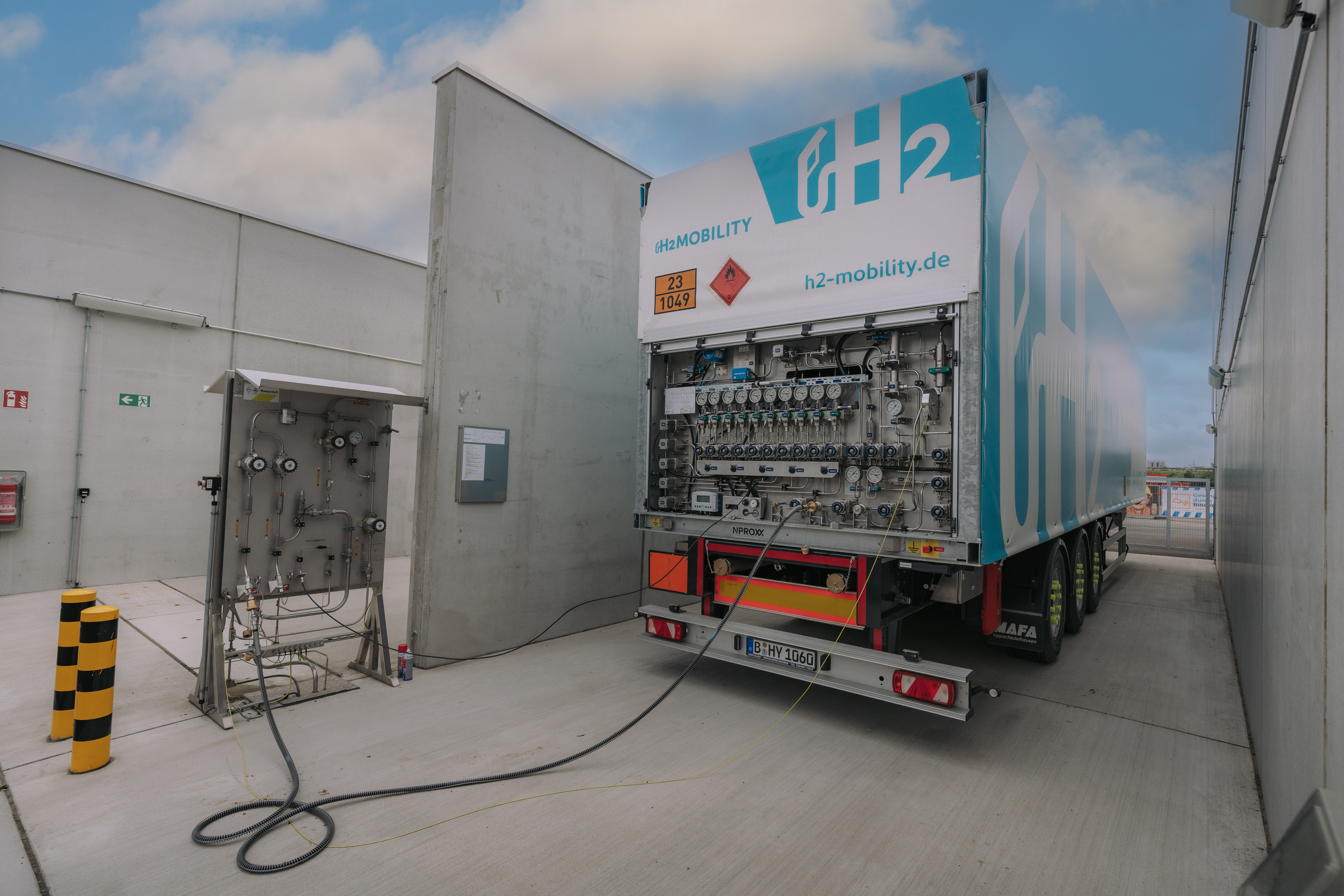 Berlin, 19 May 2026 | By building up its own logistics structures, H2 MOBILITY is taking the next step toward a high‑performance and economically viable hydrogen infrastructure. A total of six hydrogen trailers will be deployed in the future to supply the company’s refueling stations. Following several weeks of testing, the first two trailers entered regular operation today.
By operating its own trailers, H2 MOBILITY assumes operational responsibility for key parts of its supply chain. The new trailers enable flexible, demand-driven deliveries to hydrogen refuelling stations and complement existing logistics structures. The objective is to make hydrogen supply overall more efficient, reliable and independent.
Greater sovereignty over infrastructure
Compared to conventional delivery models, H2 MOBILITY can use its own trailers to manage transport processes more independently and respond more quickly to fluctuations in demand. This reduces downtime and further increases the availability of hydrogen refuelling stations.
The trailers are designed to integrate seamlessly into the existing infrastructure while enabling scalable expansion of logistics operations. With a capacity of 1,200 kilograms of hydrogen across 78 pressure vessels, the trailers are state of the art and enable the transport and delivery of significantly larger volumes per trip. This results in considerably improved supply reliability and optimised transport costs.
To build its in-house logistics capabilities, H2 MOBILITY is working in partnership with the established logistics service provider HOYER. The HOYER Group will take on key tasks in hydrogen supply and contribute its extensive expertise, particularly in transport and volume management.
“Solutions that combine security of supply, economic efficiency and scalability are crucial for the successful ramp-up of climate-friendly mobility in heavy-duty transport. With our own trailer fleet, we are making a significant contribution towards this goal. At the same time, we are creating the conditions to optimise costs across the value chain. Our partnership with HOYER demonstrates how complementary strengths can be combined effectively,” explains Frank Fronzke, Managing Director and COO of H2 MOBILITY.
Anna Krüger, Head of Sales Global Gas Logistics at the HOYER Group, adds: “We are delighted that our drivers are now on the road with H2 MOBILITY trailers. With our extensive expertise in gas logistics and precise volume planning, we will ensure reliable and safe supply to hydrogen refuelling stations going forward.”
H2 MOBILITY
H2 MOBILITY is a pioneer in the development of public hydrogen refuelling infrastructure and Europe’s largest operator of hydrogen refuelling stations. Its business areas include technical development, financing, planning, construction, marketing and operation of hydrogen stations. The company is also increasingly active in the services sector, offering consulting, station construction and operations, calibration, and quality assurance. Founded in 2015 as a project company to promote hydrogen as an emission-free fuel for road transport, H2 MOBILITY transitioned in 2022 into a long-term, commercially oriented enterprise. Its mission is to contribute to the energy transition in transport through high-performance hydrogen refuelling solutions. H2 MOBILITY aims to transition fully to renewable hydrogen by 2028.
HOYER Group
HOYER is a leading global logistics provider for the handling and transportation of liquid goods, including gases. With decades of experience and a comprehensive service portfolio, HOYER offers tailored logistics solutions for cryogenic or pressurised liquefied gases, as well as the handling of gas cylinders – worldwide.
Contact:
H2 MOBILITY: Daniela Dietz, presse@h2-mobility.de
HOYER Group: Svenja Rüde, presse@hoyer-group.com
Image: Copyright (c) H2 MOBILITY
Berlin, 19 May 2026 | By building up its own logistics structures, H2 MOBILITY is taking the next step toward a high‑performance and economically viable hydrogen infrastructure. A total of six hydrogen trailers will be deployed in the future to supply the company’s refueling stations. Following several weeks of testing, the first two trailers entered regular operation today.
By operating its own trailers, H2 MOBILITY assumes operational responsibility for key parts of its supply chain. The new trailers enable flexible, demand-driven deliveries to hydrogen refuelling stations and complement existing logistics structures. The objective is to make hydrogen supply overall more efficient, reliable and independent.
Greater sovereignty over infrastructure
Compared to conventional delivery models, H2 MOBILITY can use its own trailers to manage transport processes more independently and respond more quickly to fluctuations in demand. This reduces downtime and further increases the availability of hydrogen refuelling stations.
The trailers are designed to integrate seamlessly into the existing infrastructure while enabling scalable expansion of logistics operations. With a capacity of 1,200 kilograms of hydrogen across 78 pressure vessels, the trailers are state of the art and enable the transport and delivery of significantly larger volumes per trip. This results in considerably improved supply reliability and optimised transport costs.
To build its in-house logistics capabilities, H2 MOBILITY is working in partnership with the established logistics service provider HOYER. The HOYER Group will take on key tasks in hydrogen supply and contribute its extensive expertise, particularly in transport and volume management.
“Solutions that combine security of supply, economic efficiency and scalability are crucial for the successful ramp-up of climate-friendly mobility in heavy-duty transport. With our own trailer fleet, we are making a significant contribution towards this goal. At the same time, we are creating the conditions to optimise costs across the value chain. Our partnership with HOYER demonstrates how complementary strengths can be combined effectively,” explains Frank Fronzke, Managing Director and COO of H2 MOBILITY.
Anna Krüger, Head of Sales Global Gas Logistics at the HOYER Group, adds: “We are delighted that our drivers are now on the road with H2 MOBILITY trailers. With our extensive expertise in gas logistics and precise volume planning, we will ensure reliable and safe supply to hydrogen refuelling stations going forward.”
H2 MOBILITY
H2 MOBILITY is a pioneer in the development of public hydrogen refuelling infrastructure and Europe’s largest operator of hydrogen refuelling stations. Its business areas include technical development, financing, planning, construction, marketing and operation of hydrogen stations. The company is also increasingly active in the services sector, offering consulting, station construction and operations, calibration, and quality assurance. Founded in 2015 as a project company to promote hydrogen as an emission-free fuel for road transport, H2 MOBILITY transitioned in 2022 into a long-term, commercially oriented enterprise. Its mission is to contribute to the energy transition in transport through high-performance hydrogen refuelling solutions. H2 MOBILITY aims to transition fully to renewable hydrogen by 2028.
HOYER Group
HOYER is a leading global logistics provider for the handling and transportation of liquid goods, including gases. With decades of experience and a comprehensive service portfolio, HOYER offers tailored logistics solutions for cryogenic or pressurised liquefied gases, as well as the handling of gas cylinders – worldwide.
Contact:
H2 MOBILITY: Daniela Dietz, presse@h2-mobility.de
HOYER Group: Svenja Rüde, presse@hoyer-group.com
Image: Copyright (c) H2 MOBILITY
02.12.2025
Green hydrogen for public transport: H2 MOBILITY and rnv commission new hydrogen refuelling station in Ludwigshafen am Rhein
 The public hydrogen refuelling station located at Hauptstraße/Giulinistraße was officially opened today.
Ludwigshafen am Rhein, 2 December 2025 | At the new hydrogen refuelling station next to the Rhein-Neckar-Verkehr GmbH (rnv) depot, eight environmentally friendly eCitaro G fuel cell range-extender buses—procured by rnv under the H2Rivers funding programme—will now refuel with green hydrogen. The publicly accessible combined dispenser provides both 350-bar and 700-bar refuelling and is also used by other vehicle types, including the waste collection fuel cell truck operated by Wirtschaftsbetriebe Ludwigshafen.
The station in Ludwigshafen is the third hydrogen refuelling station jointly implemented by H2 MOBILITY and rnv. Last year already saw the opening of stations in Heidelberg-Wieblingen—located at the city’s new depot for alternative drive systems—and at the rnv depot in Mannheim. Other municipal companies and regional logistics firms also benefit from the new sites: all stations are publicly accessible and able to refuel hydrogen vehicles at both 350-bar and 700-bar pressure levels.
Federal Minister of Transport Patrick Schnieder: “Hydrogen and fuel cells are an important building block for climate-friendly mobility in the future. With around €20 million, we are supporting the HyPerformer region H2Rivers, which demonstrates in an impressive way how innovative technologies work in everyday practice. Projects like this provide crucial momentum for modern and sustainable mobility. In doing so, we are deliberately embracing technological openness — because we need all climate-friendly drive technologies to successfully advance the transformation of the transport sector.”
Dagmar Fehler, Managing Director and Spokesperson of NOW GmbH: “The opening of the new hydrogen refuelling station in Ludwigshafen sends a strong signal for Germany as a business location and for climate action. Hydrogen plays a central role in transforming the transport sector because it can complement other propulsion systems across all modes of transport in a meaningful and climate-friendly way. Future demand will be driven primarily by trucks and buses, which is why we need high-capacity, larger refuelling stations. On behalf of the Federal Ministry of Transport, NOW GmbH has been supporting the funding and market development of these technologies since 2008. With projects such as H2Rivers, we demonstrate how hydrogen—from production through to vehicle use—can be successfully put into practice. Today’s opening is another important milestone on the path towards climate-friendly mobility.”
Yunus Keskin, Lead Project Manager Alternative Powertrains, rnv: “With the new hydrogen refuelling station in Ludwigshafen, we are taking another major step towards climate-friendly public transport in the Rhine-Neckar metropolitan region. Hydrogen allows us to combine long ranges and high operational flexibility with genuine sustainability. For rnv, this is a decisive milestone in offering our passengers environmentally responsible mobility while supporting the region’s ambitious climate targets. We are demonstrating that the future of public transport is emissions-free — and hydrogen plays a key role in this transition. We particularly welcome the use of green hydrogen, as it represents a truly climate-friendly alternative. Investing in this technology is not only technical progress, it is a clear commitment to future generations. With every new vehicle and every new hydrogen refuelling station based on green hydrogen, we significantly reduce CO2 emissions and make a tangible contribution to the energy transition. Our goal is to establish public transport as a leader in sustainable mobility and to further enhance the region’s quality of life.”
Martin Jüngel, Managing Director and CFO of H2 MOBILITY: “Together with rnv, wesuccessfully entered the world of hydrogen mobility last year in Heidelberg and Mannheim. We are proving that hydrogen refuelling works reliably and is fully suited to everyday operations. The daily refuelling of 40 buses in both cities has been highly reliable from day one. I am delighted that we are now entering day-to-day operations in Ludwigshafen as well. In the Rhine-Neckar region, each new station increases supply security for hydrogen and boosts the attractiveness of hydrogen mobility. Nowhere else in Germany is the transition to hydrogen made as straightforward as in the Rhine-Neckar metropolitan region—and no other region offers such a modern infrastructure combined with a completely green hydrogen supply. Across all our sites—Ludwigshafen, Frankenthal, Mannheim and Heidelberg—we will be supplying exclusively green hydrogen by next year.”
Alexander Thewalt, Department Head of Construction, Environment and Transport, City of Ludwigshafen:
“After a hydrogen refuelling station opened last year to the north of Ludwigshafen in Frankenthal, the southern part of the city is now following suit. The city and the public transport operator will become regular users with a waste collection vehicle and articulated buses. Together with H2 MOBILITY, we hope that the attractive location at the Rhine port — with its many commercial enterprises — will encourage use by vehicles from these local businesses.”
Pilot project for hydrogen mobility in the Rhine-Neckar region
How can hydrogen be produced locally, distributed efficiently and used to enable climate-friendly mobility? The H2Rivers and H2Rhein-Neckar funding projects — with a combined project volume of nearly €100 million — provide the answers. Over the past two years, a dynamic hydrogen ecosystem has emerged in the Rhine-Neckar metropolitan region, comprising four hydrogen refuelling stations operated by H2 MOBILITY, 48 fuel cell buses and ten hydrogen-powered waste collection vehicles. The H2Rhein-Neckar and H2Rivers projects demonstrate the deployment of new hydrogen technologies and pave the way for regional value chains. The introduction of fuel cell range-extender buses in public transport also generates essential insights for municipalities and bus operators, supported by scientific monitoring.
Dr Doris Wittneben, Head of Future Fields and Innovation, Metropolregion Rhein-Neckar GmbH:
“The new hydrogen refuelling station is another key milestone for regional development in the metropolitan region. As a pilot region for the establishment of a functioning hydrogen ecosystem, we are demonstrating what innovation in the mobility sector can look like — sustainable, forward-looking and economically strong. We are pleased that, through coordinating the H2Rivers project, MRN GmbH has been able to support this success.”
H2Rivers: Hydrogen demonstration project Rhine-Neckar
H2Rivers is part of the Federal Ministry of Transport’s HyLand programme in the HyPerformer category. The project paves the way for the widespread market entry of zero-emission hydrogen and fuel cell technologies in the mobility sector within the Rhine-Neckar metropolitan region and the central Neckar area. The development of the Rhine-Neckar metropolitan region as a hydrogen hub is supported under the National Innovation Programme for Hydrogen and Fuel Cell Technology (NIP2) as one of the winning regions of the “HyLand – Hydrogen Regions in Germany” initiative, with up to €20 million in investment grants from the Federal Ministry of Transport. The project is coordinated by Metropolregion Rhein-Neckar GmbH. The hydrogen refuelling station in Ludwigshafen am Rhein is receiving €1,284,000 in funding. The funding guideline is coordinated by NOW GmbH and implemented by Project Management Jülich (PtJ).
H2 MOBILITY
H2 MOBILITY is a pioneer in the development of public hydrogen refuelling infrastructure and Europe’s largest operator of hydrogen refuelling stations. Its business areas include technical development, financing, planning, construction, marketing and operation of hydrogen stations. The company is also increasingly active in the services sector, offering consulting, station construction and operations, calibration, and quality assurance. Founded in 2015 as a project company to promote hydrogen as an emission-free fuel for road transport, H2 MOBILITY transitioned in 2022 into a long-term, commercially oriented enterprise. Its mission is to contribute to the energy transition in transport through high-performance hydrogen refuelling solutions. H2 MOBILITY aims to transition fully to renewable hydrogen by 2028.
Alternative drive systems at rnv
Further information on e-buses, hydrogen fuel cells and alternative drive technologies at rnv can be found at www.rnv-online.de/alternative-antriebe.
Metropolregion Rhein-Neckar
Metropolregion Rhein-Neckar GmbH (Mannheim) was established in 2006. In addition to the Verband Region Rhein-Neckar and the Zukunft Metropolregion Rhein-Neckar e. V. association, its shareholders include the Chambers of Industry and Commerce for Rhein-Neckar, Pfalz and Darmstadt as well as the Chambers of Crafts for Mannheim and Rhein-Main. Working in cooperation with these and many other regional stakeholders, the Regional Development Corporation coordinates project work across the fields of energy, mobility, innovation, labour markets, education, healthcare, digitalisation, culture and administrative modernisation. It also plays a key role in regional marketing and communications, helping to strengthen the visibility and reputation of the Rhine-Neckar region. The MRN GmbH Future Fields and Innovation division coordinates the H2Rivers project.
The public hydrogen refuelling station located at Hauptstraße/Giulinistraße was officially opened today.
Ludwigshafen am Rhein, 2 December 2025 | At the new hydrogen refuelling station next to the Rhein-Neckar-Verkehr GmbH (rnv) depot, eight environmentally friendly eCitaro G fuel cell range-extender buses—procured by rnv under the H2Rivers funding programme—will now refuel with green hydrogen. The publicly accessible combined dispenser provides both 350-bar and 700-bar refuelling and is also used by other vehicle types, including the waste collection fuel cell truck operated by Wirtschaftsbetriebe Ludwigshafen.
The station in Ludwigshafen is the third hydrogen refuelling station jointly implemented by H2 MOBILITY and rnv. Last year already saw the opening of stations in Heidelberg-Wieblingen—located at the city’s new depot for alternative drive systems—and at the rnv depot in Mannheim. Other municipal companies and regional logistics firms also benefit from the new sites: all stations are publicly accessible and able to refuel hydrogen vehicles at both 350-bar and 700-bar pressure levels.
Federal Minister of Transport Patrick Schnieder: “Hydrogen and fuel cells are an important building block for climate-friendly mobility in the future. With around €20 million, we are supporting the HyPerformer region H2Rivers, which demonstrates in an impressive way how innovative technologies work in everyday practice. Projects like this provide crucial momentum for modern and sustainable mobility. In doing so, we are deliberately embracing technological openness — because we need all climate-friendly drive technologies to successfully advance the transformation of the transport sector.”
Dagmar Fehler, Managing Director and Spokesperson of NOW GmbH: “The opening of the new hydrogen refuelling station in Ludwigshafen sends a strong signal for Germany as a business location and for climate action. Hydrogen plays a central role in transforming the transport sector because it can complement other propulsion systems across all modes of transport in a meaningful and climate-friendly way. Future demand will be driven primarily by trucks and buses, which is why we need high-capacity, larger refuelling stations. On behalf of the Federal Ministry of Transport, NOW GmbH has been supporting the funding and market development of these technologies since 2008. With projects such as H2Rivers, we demonstrate how hydrogen—from production through to vehicle use—can be successfully put into practice. Today’s opening is another important milestone on the path towards climate-friendly mobility.”
Yunus Keskin, Lead Project Manager Alternative Powertrains, rnv: “With the new hydrogen refuelling station in Ludwigshafen, we are taking another major step towards climate-friendly public transport in the Rhine-Neckar metropolitan region. Hydrogen allows us to combine long ranges and high operational flexibility with genuine sustainability. For rnv, this is a decisive milestone in offering our passengers environmentally responsible mobility while supporting the region’s ambitious climate targets. We are demonstrating that the future of public transport is emissions-free — and hydrogen plays a key role in this transition. We particularly welcome the use of green hydrogen, as it represents a truly climate-friendly alternative. Investing in this technology is not only technical progress, it is a clear commitment to future generations. With every new vehicle and every new hydrogen refuelling station based on green hydrogen, we significantly reduce CO2 emissions and make a tangible contribution to the energy transition. Our goal is to establish public transport as a leader in sustainable mobility and to further enhance the region’s quality of life.”
Martin Jüngel, Managing Director and CFO of H2 MOBILITY: “Together with rnv, wesuccessfully entered the world of hydrogen mobility last year in Heidelberg and Mannheim. We are proving that hydrogen refuelling works reliably and is fully suited to everyday operations. The daily refuelling of 40 buses in both cities has been highly reliable from day one. I am delighted that we are now entering day-to-day operations in Ludwigshafen as well. In the Rhine-Neckar region, each new station increases supply security for hydrogen and boosts the attractiveness of hydrogen mobility. Nowhere else in Germany is the transition to hydrogen made as straightforward as in the Rhine-Neckar metropolitan region—and no other region offers such a modern infrastructure combined with a completely green hydrogen supply. Across all our sites—Ludwigshafen, Frankenthal, Mannheim and Heidelberg—we will be supplying exclusively green hydrogen by next year.”
Alexander Thewalt, Department Head of Construction, Environment and Transport, City of Ludwigshafen:
“After a hydrogen refuelling station opened last year to the north of Ludwigshafen in Frankenthal, the southern part of the city is now following suit. The city and the public transport operator will become regular users with a waste collection vehicle and articulated buses. Together with H2 MOBILITY, we hope that the attractive location at the Rhine port — with its many commercial enterprises — will encourage use by vehicles from these local businesses.”
Pilot project for hydrogen mobility in the Rhine-Neckar region
How can hydrogen be produced locally, distributed efficiently and used to enable climate-friendly mobility? The H2Rivers and H2Rhein-Neckar funding projects — with a combined project volume of nearly €100 million — provide the answers. Over the past two years, a dynamic hydrogen ecosystem has emerged in the Rhine-Neckar metropolitan region, comprising four hydrogen refuelling stations operated by H2 MOBILITY, 48 fuel cell buses and ten hydrogen-powered waste collection vehicles. The H2Rhein-Neckar and H2Rivers projects demonstrate the deployment of new hydrogen technologies and pave the way for regional value chains. The introduction of fuel cell range-extender buses in public transport also generates essential insights for municipalities and bus operators, supported by scientific monitoring.
Dr Doris Wittneben, Head of Future Fields and Innovation, Metropolregion Rhein-Neckar GmbH:
“The new hydrogen refuelling station is another key milestone for regional development in the metropolitan region. As a pilot region for the establishment of a functioning hydrogen ecosystem, we are demonstrating what innovation in the mobility sector can look like — sustainable, forward-looking and economically strong. We are pleased that, through coordinating the H2Rivers project, MRN GmbH has been able to support this success.”
H2Rivers: Hydrogen demonstration project Rhine-Neckar
H2Rivers is part of the Federal Ministry of Transport’s HyLand programme in the HyPerformer category. The project paves the way for the widespread market entry of zero-emission hydrogen and fuel cell technologies in the mobility sector within the Rhine-Neckar metropolitan region and the central Neckar area. The development of the Rhine-Neckar metropolitan region as a hydrogen hub is supported under the National Innovation Programme for Hydrogen and Fuel Cell Technology (NIP2) as one of the winning regions of the “HyLand – Hydrogen Regions in Germany” initiative, with up to €20 million in investment grants from the Federal Ministry of Transport. The project is coordinated by Metropolregion Rhein-Neckar GmbH. The hydrogen refuelling station in Ludwigshafen am Rhein is receiving €1,284,000 in funding. The funding guideline is coordinated by NOW GmbH and implemented by Project Management Jülich (PtJ).
H2 MOBILITY
H2 MOBILITY is a pioneer in the development of public hydrogen refuelling infrastructure and Europe’s largest operator of hydrogen refuelling stations. Its business areas include technical development, financing, planning, construction, marketing and operation of hydrogen stations. The company is also increasingly active in the services sector, offering consulting, station construction and operations, calibration, and quality assurance. Founded in 2015 as a project company to promote hydrogen as an emission-free fuel for road transport, H2 MOBILITY transitioned in 2022 into a long-term, commercially oriented enterprise. Its mission is to contribute to the energy transition in transport through high-performance hydrogen refuelling solutions. H2 MOBILITY aims to transition fully to renewable hydrogen by 2028.
Alternative drive systems at rnv
Further information on e-buses, hydrogen fuel cells and alternative drive technologies at rnv can be found at www.rnv-online.de/alternative-antriebe.
Metropolregion Rhein-Neckar
Metropolregion Rhein-Neckar GmbH (Mannheim) was established in 2006. In addition to the Verband Region Rhein-Neckar and the Zukunft Metropolregion Rhein-Neckar e. V. association, its shareholders include the Chambers of Industry and Commerce for Rhein-Neckar, Pfalz and Darmstadt as well as the Chambers of Crafts for Mannheim and Rhein-Main. Working in cooperation with these and many other regional stakeholders, the Regional Development Corporation coordinates project work across the fields of energy, mobility, innovation, labour markets, education, healthcare, digitalisation, culture and administrative modernisation. It also plays a key role in regional marketing and communications, helping to strengthen the visibility and reputation of the Rhine-Neckar region. The MRN GmbH Future Fields and Innovation division coordinates the H2Rivers project.
Contact: H2 MOBILITY Deutschland GmbH & Co. KG: Daniela Dietz, presse@h2-mobility.de Rhein-Neckar-Verkehr (rnv) GmbH: René Weintz, presse@rnv-online.de Metropolregion Rhein-Neckar (MRN) GmbH: Wiebke Krull, wiebke.krull@m-r-n.com
Image: Copyright (c) Nikola Neven Haubner; from left to right:-
Martin Jüngel, Managing Director and CFO, H2 MOBILITY
-
Yunus Keskin, Lead Project Manager for Alternative Powertrains, rnv
-
Alexander Thewalt, Department Head of Construction, Environment and Transport, City of Ludwigshafen
-
Dr Doris Wittneben, Head of Future Fields and Innovation, MRN
-
Dagmar Fehler, Managing Director and Spokesperson, NOW
19.11.2025
“Connecting the Dots”: Building a Growing Hydrogen Refuelling Network Across Europe
 Berlin, 19 November 2025 | New hydrogen station alliance urges OEMs to accelerate the next phase of hydrogen mobility through vehicle rollout and expanded model offerings.
Six leading European operators of hydrogen refuelling stations have formed the H2 Infrastructure Alliance to accelerate the rollout of hydrogen mobility. The alliance stresses the importance for the availability of vehicle models. The goal is to align and speed-up infrastructure and vehicle deployment until 2028.
The Hydrogen Infrastructure Alliance (H2IA)
The alliance includes prominent members from various European member states – Hydri (Sweden), TEAL Mobility (France), Fountain Fuel (Netherlands), H2 MOBILITY (Germany), Virya Energy (Belgium) and HYmpulsion (France). These companies jointly operate 92 hydrogen refuelling stations (HRS) for light- and heavy-duty fleets, with 39 more large-scale stations planned by 2028 – which will be enough to refuel over 1,800 trucks daily. The alliance has initiated conversations with leading vehicle manufacturers about accelerating hydrogen mobility.
Breaking the chicken – or egg dilemma
With an ambitious yet realistic pace, it will be possible to realize a connected network of stations that cover Europe. This is what the alliance refers to as ‘Connecting the Dots’, as illustrated on the attached map. By taking the lead and expanding the refuelling infrastructure first, it is possible to break through what is often described as the chicken-or-egg dilemma.
Refuelling infrastructure provides the vehicle manufacturers with confidence to ramp-up vehicle development and deployment efforts. Larger volumes of vehicles and a variety of models available, in turn, lead to a quicker growth of the refuelling network – and, most importantly, to a lower cost for end-users, both for vehicles and for hydrogen fuel.
Berlin, 19 November 2025 | New hydrogen station alliance urges OEMs to accelerate the next phase of hydrogen mobility through vehicle rollout and expanded model offerings.
Six leading European operators of hydrogen refuelling stations have formed the H2 Infrastructure Alliance to accelerate the rollout of hydrogen mobility. The alliance stresses the importance for the availability of vehicle models. The goal is to align and speed-up infrastructure and vehicle deployment until 2028.
The Hydrogen Infrastructure Alliance (H2IA)
The alliance includes prominent members from various European member states – Hydri (Sweden), TEAL Mobility (France), Fountain Fuel (Netherlands), H2 MOBILITY (Germany), Virya Energy (Belgium) and HYmpulsion (France). These companies jointly operate 92 hydrogen refuelling stations (HRS) for light- and heavy-duty fleets, with 39 more large-scale stations planned by 2028 – which will be enough to refuel over 1,800 trucks daily. The alliance has initiated conversations with leading vehicle manufacturers about accelerating hydrogen mobility.
Breaking the chicken – or egg dilemma
With an ambitious yet realistic pace, it will be possible to realize a connected network of stations that cover Europe. This is what the alliance refers to as ‘Connecting the Dots’, as illustrated on the attached map. By taking the lead and expanding the refuelling infrastructure first, it is possible to break through what is often described as the chicken-or-egg dilemma.
Refuelling infrastructure provides the vehicle manufacturers with confidence to ramp-up vehicle development and deployment efforts. Larger volumes of vehicles and a variety of models available, in turn, lead to a quicker growth of the refuelling network – and, most importantly, to a lower cost for end-users, both for vehicles and for hydrogen fuel.
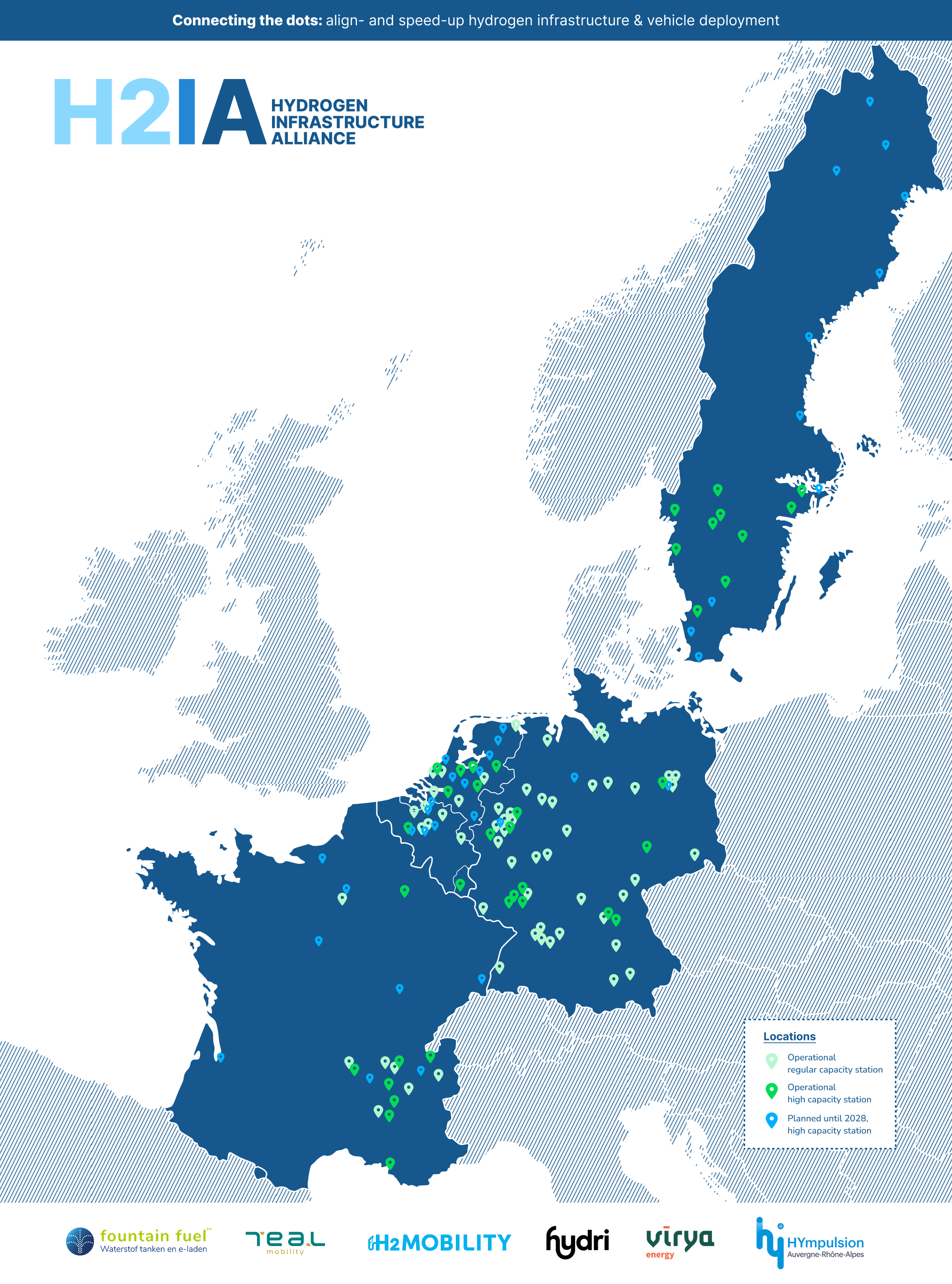 Connecting the dots
The rollout of hydrogen vehicles and refuelling stations mirrors how the build-out of mobile infrastructure and networks fueled the rapid rise of mobile phone use in the early 2000s. Transmission towers and good signal coverage led to a strong increase in mobile telephone use. In return, this led to the placement of more, and improved, transmission towers and ultimately to advancements such as the G5 networks. With high numbers of transmission towers, mobile phones and high utilizations rates the total costs of using the system decreased.
Hydrogen is alive & kicking
The potential for hydrogen vehicles is growing. “Our focus is on advancing the regulatory framework at the European level. Heavy-duty transport is a decisive driver of hydrogen mobility in Europe. We see this every day at our stations in Germany, where buses and trucks already account for well over 70 per cent of demand. It is essential that we continue on this path across Europe. The H2 Infrastructure Alliance sends an important signal in this respect: the development of a pan-European refuelling network is already well under way and now requires clear commitment from OEMs to increase vehicle numbers,” explains Martin Jüngel, Managing Director and CFO of H2 MOBILITY.
Hydrogen is complementary to battery-electric
The members of the H2IA stress that battery-electric and hydrogen are complementary techniques. Both technologies are needed to meet diverse customer needs – from long-haul transport and flexibility requirements, to ‘convoi exceptionnel’ transport and intensive operations. Hydrogen is particularly important in regions where electric grid capacity constrains the deployment of fast-charging infrastructure.
About H2 Infrastructure Alliance
The Hydrogen Infrastructure Alliance (H2IA) was founded by the leading EU-operators of hydrogen refuelling infrastructure: Hydri, H2 MOBILITY, Fountain Fuel, TEAL Mobility, HYmpulsion and Virya Energy. The alliance intents to coordinate and speed-up infrastructure and vehicle deployment efforts for hydrogen mobility until 2028. The goal is to realize a connected network of stations that cover Europe, which is what the alliance calls ‘Connecting the Dots’.
About H2 MOBILITY
H2 MOBILITY is a pioneer in the development of public hydrogen refuelling infrastructure and Europe’s largest operator of hydrogen refuelling stations. Its business areas include technical development, financing, planning, construction, marketing and operation of hydrogen stations. The company is also increasingly active in the services sector, offering consulting, station construction and operations, calibration, and quality assurance. Founded in 2015 as a project company to promote hydrogen as an emission-free fuel for road transport, H2 MOBILITY transitioned in 2022 into a long-term, commercially oriented enterprise. Its mission is to contribute to the energy transition in transport through high-performance hydrogen refuelling solutions. H2 MOBILITY aims to transition fully to renewable hydrogen by 2028.
Contact:
H2 MOBILITY: Daniela Dietz, presse@h2-mobility.de
Weitere Informationen unter www.h2-mobility.de
Connecting the dots
The rollout of hydrogen vehicles and refuelling stations mirrors how the build-out of mobile infrastructure and networks fueled the rapid rise of mobile phone use in the early 2000s. Transmission towers and good signal coverage led to a strong increase in mobile telephone use. In return, this led to the placement of more, and improved, transmission towers and ultimately to advancements such as the G5 networks. With high numbers of transmission towers, mobile phones and high utilizations rates the total costs of using the system decreased.
Hydrogen is alive & kicking
The potential for hydrogen vehicles is growing. “Our focus is on advancing the regulatory framework at the European level. Heavy-duty transport is a decisive driver of hydrogen mobility in Europe. We see this every day at our stations in Germany, where buses and trucks already account for well over 70 per cent of demand. It is essential that we continue on this path across Europe. The H2 Infrastructure Alliance sends an important signal in this respect: the development of a pan-European refuelling network is already well under way and now requires clear commitment from OEMs to increase vehicle numbers,” explains Martin Jüngel, Managing Director and CFO of H2 MOBILITY.
Hydrogen is complementary to battery-electric
The members of the H2IA stress that battery-electric and hydrogen are complementary techniques. Both technologies are needed to meet diverse customer needs – from long-haul transport and flexibility requirements, to ‘convoi exceptionnel’ transport and intensive operations. Hydrogen is particularly important in regions where electric grid capacity constrains the deployment of fast-charging infrastructure.
About H2 Infrastructure Alliance
The Hydrogen Infrastructure Alliance (H2IA) was founded by the leading EU-operators of hydrogen refuelling infrastructure: Hydri, H2 MOBILITY, Fountain Fuel, TEAL Mobility, HYmpulsion and Virya Energy. The alliance intents to coordinate and speed-up infrastructure and vehicle deployment efforts for hydrogen mobility until 2028. The goal is to realize a connected network of stations that cover Europe, which is what the alliance calls ‘Connecting the Dots’.
About H2 MOBILITY
H2 MOBILITY is a pioneer in the development of public hydrogen refuelling infrastructure and Europe’s largest operator of hydrogen refuelling stations. Its business areas include technical development, financing, planning, construction, marketing and operation of hydrogen stations. The company is also increasingly active in the services sector, offering consulting, station construction and operations, calibration, and quality assurance. Founded in 2015 as a project company to promote hydrogen as an emission-free fuel for road transport, H2 MOBILITY transitioned in 2022 into a long-term, commercially oriented enterprise. Its mission is to contribute to the energy transition in transport through high-performance hydrogen refuelling solutions. H2 MOBILITY aims to transition fully to renewable hydrogen by 2028.
Contact:
H2 MOBILITY: Daniela Dietz, presse@h2-mobility.de
Weitere Informationen unter www.h2-mobility.de
18.11.2025
Hydrogen for 8 Euros per kilogram now possible: hylane and H2 MOBILITY enable cost-effective operation of hydrogen trucks
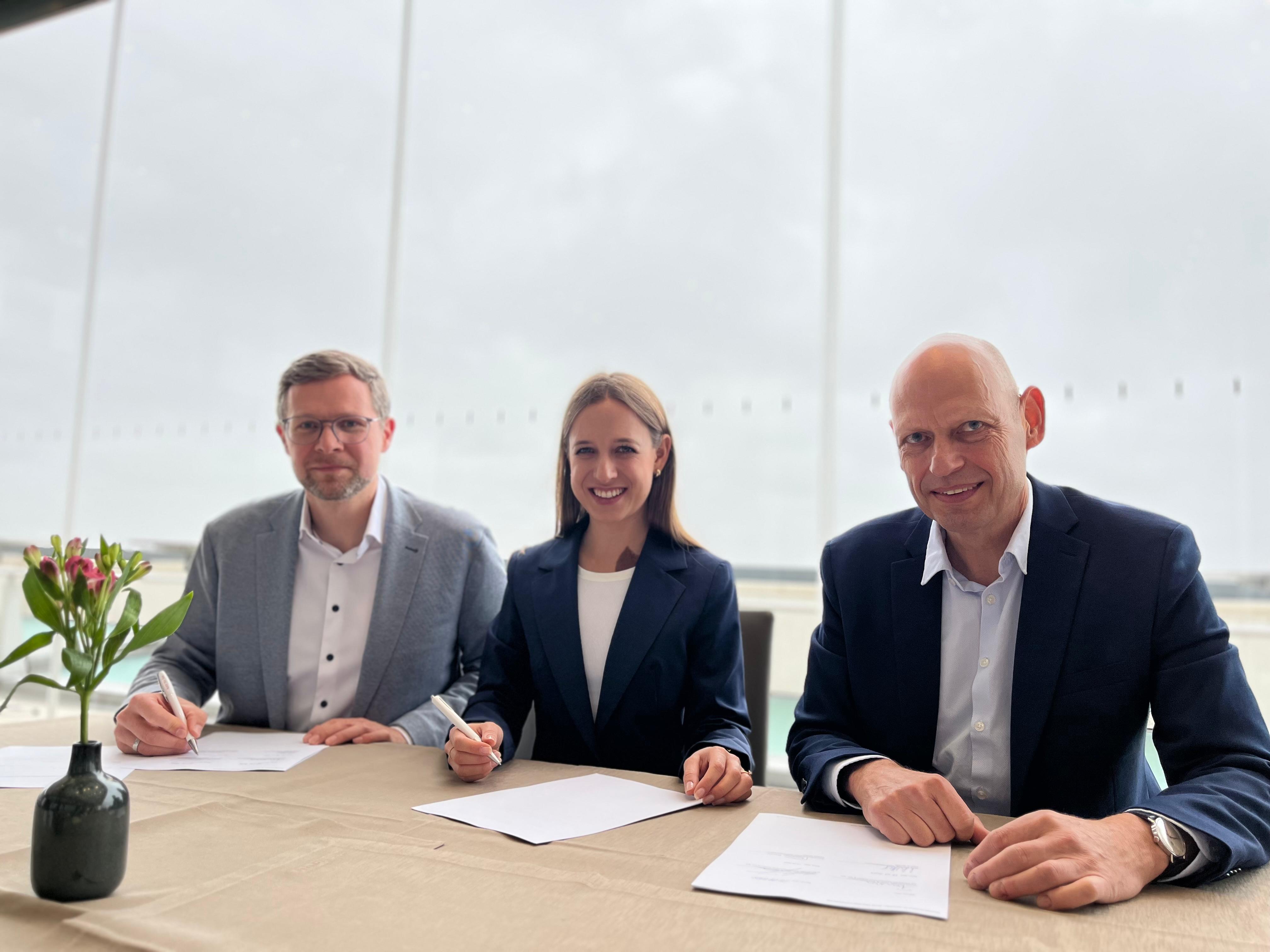 Cologne, 18 November 2025 | From 1 January 2026, hylane customers will be able to refuel at selected H2 MOBILITY hydrogen refuelling stations for around 8 euros (net) per kilogram. This is made possible by contractually secured offtake volumes, high-capacity stations and green hydrogen in combination with the greenhouse gas quota trading system. The new price marks a significant step towards the commercial viability of hydrogen trucks. The offer is available exclusively via the hylane fuel card and applies in Düsseldorf and the Rhine-Neckar region.
The reduced price is offered at large, high-performance H2 MOBILITY hydrogen refuelling stations in the two regions. These sites are located along major transport corridors and ensure cost-efficient and reliable refuelling for hydrogen trucks in daily operations. At roughly 8 euros per kilogram, the price is well below current market levels and brings the operation of fuel-cell trucks much closer to cost parity with diesel vehicles for the first time. Together with the extended toll exemption for zero-emission trucks until 2031, this represents a crucial step towards economically viable, low-carbon heavy-duty fleets.
Lower costs through guaranteed offtake volumes and consolidation
The new price level is the result of a strategic partnership: hylane pools the hydrogen demand of its fleet customers – including leading logistics and retail companies – and guarantees H2 MOBILITY consistently high offtake volumes. This planning security enables better utilisation of the stations and allows H2 MOBILITY to procure hydrogen strategically and cost-efficiently. The result is stable, reduced prices that support the economic operation of hydrogen trucks in everyday use.
Green hydrogen from regional production
At the participating stations in Düsseldorf and Rhine-Neckar, customers refuel exclusively with green hydrogen. It is produced locally via electrolysis using renewable energy and delivered to nearby stations by swap-body trailers. Short transport distances between production sites and hydrogen refuelling stations reduce costs and improve the CO2 balance across the value chain. Policy instruments such as greenhouse gas quota trading and RFNBO certification (Renewable Fuels of Non-Biological Origin) under the European Renewable Energy Directive RED III create further incentives for the use of renewable fuels, actively promoting the expansion of green hydrogen infrastructure. As early as 2024, around one-third of the hydrogen refuelling stations used by hylane were already supplying green hydrogen – with the trend rising.
CO2 reporting included
hylane’s fuel-cell trucks operate with zero emissions in use (“tank-to-wheel”). Emissions arise only in upstream processes such as production, transport and provision of hydrogen (“well-to-tank”). By using 100 % green hydrogen, CO2 emissions can be reduced by up to 90 % compared with diesel trucks – from fuel production through to road operation (“well-to-wheel”). hylane customers receive CO2 reports verified by DEKRA. These reports are recognised by auditors and can be used in sustainability reporting in line with the EU Corporate Sustainability Reporting Directive (CSRD). This makes the climate impact of the deployed vehicles transparent, traceable and verifiable.
A strong signal for the industry
The cooperation between hylane, one of Europe’s leading providers of zero-emission trucks, and H2 MOBILITY, the continent’s largest operator of public hydrogen refuelling stations, sends a clear message about the viability of hydrogen mobility. The reduced price supports companies in decarbonising their fleets sustainably and economically—a decisive contribution to scaling up climate-friendly heavy-duty transport.
Dr Sara Schiffer, Managing Director, hylane: “Setting the price at around 8 euros per kilogram marks an important milestone. It demonstrates that hydrogen trucks are not only environmentally sound but also economically viable. This is a crucial step towards decarbonising heavy road freight and accelerating the growth of the hydrogen economy—well beyond the transport sector.”
Martin Jüngel, Managing Director and CFO, H2 MOBILITY: “Through close cooperation along the hydrogen value chain, we are proving that the economic operation of hydrogen trucks is already feasible in practice today. We repeatedly highlight the importance of long-term political frameworks for the commercial use of green hydrogen. We are delighted to demonstrate this in practice for the first time. Only then can infrastructure operators, vehicle providers and customers gain the necessary confidence to switch to sustainable transport and mobility solutions.”
About hylane
hylane is among Europe’s leading providers of zero-emission trucks. Founded in Cologne in 2021 as Germany’s first zero-emission commercial vehicle rental company, its mission is to support businesses in decarbonising their truck fleets. hylane supplies battery-electric and hydrogen-powered vehicles from various manufacturers through a comprehensive usage-based rental model; customers pay only for the kilometres driven. hylane manages vehicle procurement and registration, maintenance and repairs, insurance, access to energy supply and regulatory compliance, including CO₂ certification. hylane makes the transition to climate-friendly trucks not only efficient and cost-effective, but also significantly easier. Leading fleet operators from logistics, retail and industry already rely on hylane as a strategic partner for fleet decarbonisation.
About H2 MOBILITY
H2 MOBILITY is a pioneer in the development of public hydrogen refuelling infrastructure and Europe’s largest operator of hydrogen refuelling stations. Its business areas include technical development, financing, planning, construction, marketing and operation of hydrogen stations. The company is also increasingly active in the services sector, offering consulting, station construction and operations, calibration, and quality assurance. Founded in 2015 as a project company to promote hydrogen as an emission-free fuel for road transport, H2 MOBILITY transitioned in 2022 into a long-term, commercially oriented enterprise. Its mission is to contribute to the energy transition in transport through high-performance hydrogen refuelling solutions. H2 MOBILITY aims to transition fully to renewable hydrogen by 2028.
Contact:
hylane: Weena Ghosh, presse@hylane.de
H2 MOBILITY: Daniela Dietz, presse@h2-mobility.de
Image: Copyright (c) H2 MOBILITY; from left to right:
Cologne, 18 November 2025 | From 1 January 2026, hylane customers will be able to refuel at selected H2 MOBILITY hydrogen refuelling stations for around 8 euros (net) per kilogram. This is made possible by contractually secured offtake volumes, high-capacity stations and green hydrogen in combination with the greenhouse gas quota trading system. The new price marks a significant step towards the commercial viability of hydrogen trucks. The offer is available exclusively via the hylane fuel card and applies in Düsseldorf and the Rhine-Neckar region.
The reduced price is offered at large, high-performance H2 MOBILITY hydrogen refuelling stations in the two regions. These sites are located along major transport corridors and ensure cost-efficient and reliable refuelling for hydrogen trucks in daily operations. At roughly 8 euros per kilogram, the price is well below current market levels and brings the operation of fuel-cell trucks much closer to cost parity with diesel vehicles for the first time. Together with the extended toll exemption for zero-emission trucks until 2031, this represents a crucial step towards economically viable, low-carbon heavy-duty fleets.
Lower costs through guaranteed offtake volumes and consolidation
The new price level is the result of a strategic partnership: hylane pools the hydrogen demand of its fleet customers – including leading logistics and retail companies – and guarantees H2 MOBILITY consistently high offtake volumes. This planning security enables better utilisation of the stations and allows H2 MOBILITY to procure hydrogen strategically and cost-efficiently. The result is stable, reduced prices that support the economic operation of hydrogen trucks in everyday use.
Green hydrogen from regional production
At the participating stations in Düsseldorf and Rhine-Neckar, customers refuel exclusively with green hydrogen. It is produced locally via electrolysis using renewable energy and delivered to nearby stations by swap-body trailers. Short transport distances between production sites and hydrogen refuelling stations reduce costs and improve the CO2 balance across the value chain. Policy instruments such as greenhouse gas quota trading and RFNBO certification (Renewable Fuels of Non-Biological Origin) under the European Renewable Energy Directive RED III create further incentives for the use of renewable fuels, actively promoting the expansion of green hydrogen infrastructure. As early as 2024, around one-third of the hydrogen refuelling stations used by hylane were already supplying green hydrogen – with the trend rising.
CO2 reporting included
hylane’s fuel-cell trucks operate with zero emissions in use (“tank-to-wheel”). Emissions arise only in upstream processes such as production, transport and provision of hydrogen (“well-to-tank”). By using 100 % green hydrogen, CO2 emissions can be reduced by up to 90 % compared with diesel trucks – from fuel production through to road operation (“well-to-wheel”). hylane customers receive CO2 reports verified by DEKRA. These reports are recognised by auditors and can be used in sustainability reporting in line with the EU Corporate Sustainability Reporting Directive (CSRD). This makes the climate impact of the deployed vehicles transparent, traceable and verifiable.
A strong signal for the industry
The cooperation between hylane, one of Europe’s leading providers of zero-emission trucks, and H2 MOBILITY, the continent’s largest operator of public hydrogen refuelling stations, sends a clear message about the viability of hydrogen mobility. The reduced price supports companies in decarbonising their fleets sustainably and economically—a decisive contribution to scaling up climate-friendly heavy-duty transport.
Dr Sara Schiffer, Managing Director, hylane: “Setting the price at around 8 euros per kilogram marks an important milestone. It demonstrates that hydrogen trucks are not only environmentally sound but also economically viable. This is a crucial step towards decarbonising heavy road freight and accelerating the growth of the hydrogen economy—well beyond the transport sector.”
Martin Jüngel, Managing Director and CFO, H2 MOBILITY: “Through close cooperation along the hydrogen value chain, we are proving that the economic operation of hydrogen trucks is already feasible in practice today. We repeatedly highlight the importance of long-term political frameworks for the commercial use of green hydrogen. We are delighted to demonstrate this in practice for the first time. Only then can infrastructure operators, vehicle providers and customers gain the necessary confidence to switch to sustainable transport and mobility solutions.”
About hylane
hylane is among Europe’s leading providers of zero-emission trucks. Founded in Cologne in 2021 as Germany’s first zero-emission commercial vehicle rental company, its mission is to support businesses in decarbonising their truck fleets. hylane supplies battery-electric and hydrogen-powered vehicles from various manufacturers through a comprehensive usage-based rental model; customers pay only for the kilometres driven. hylane manages vehicle procurement and registration, maintenance and repairs, insurance, access to energy supply and regulatory compliance, including CO₂ certification. hylane makes the transition to climate-friendly trucks not only efficient and cost-effective, but also significantly easier. Leading fleet operators from logistics, retail and industry already rely on hylane as a strategic partner for fleet decarbonisation.
About H2 MOBILITY
H2 MOBILITY is a pioneer in the development of public hydrogen refuelling infrastructure and Europe’s largest operator of hydrogen refuelling stations. Its business areas include technical development, financing, planning, construction, marketing and operation of hydrogen stations. The company is also increasingly active in the services sector, offering consulting, station construction and operations, calibration, and quality assurance. Founded in 2015 as a project company to promote hydrogen as an emission-free fuel for road transport, H2 MOBILITY transitioned in 2022 into a long-term, commercially oriented enterprise. Its mission is to contribute to the energy transition in transport through high-performance hydrogen refuelling solutions. H2 MOBILITY aims to transition fully to renewable hydrogen by 2028.
Contact:
hylane: Weena Ghosh, presse@hylane.de
H2 MOBILITY: Daniela Dietz, presse@h2-mobility.de
Image: Copyright (c) H2 MOBILITY; from left to right:
- Martin Jüngel, Managing Director, H2 MOBILITY,
- Dr Sara Schiffer, Managing Director, hylane
- Frank Fronzke, Managing Director, H2 MOBILITY, during the contract signing
10.11.2025
H2 MOBILITY continues its transformation: from first-generation hydrogen refuelling stations to new high-performance sites
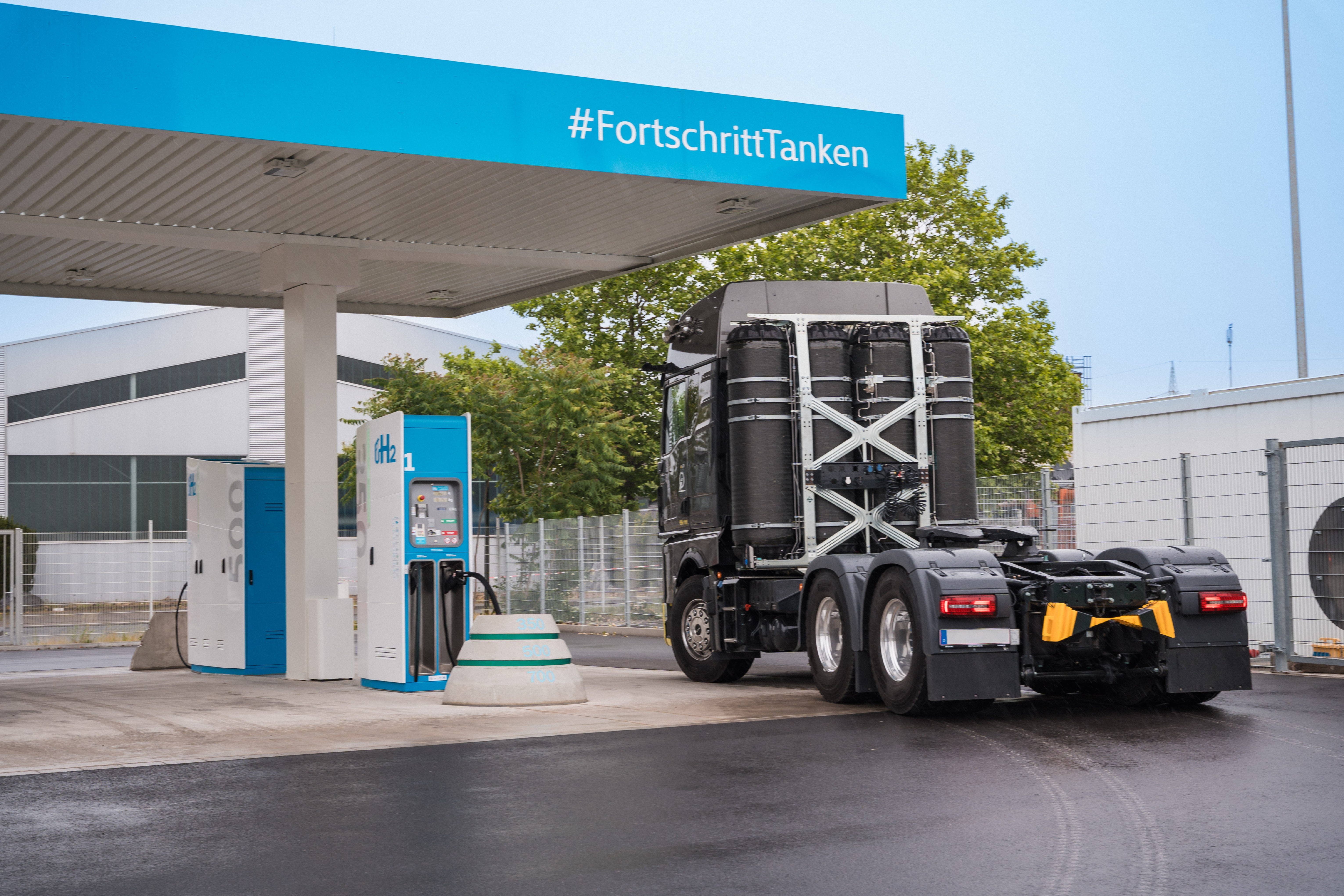 Berlin, 10 November 2025 | The company reaffirms its focus on high-performance hydrogen refuelling stations for both light and heavy-duty vehicles and continues to make progress in its crucial transformation process to provide robust and efficient refuelling for commercial vehicles such as buses, trucks and waste collection vehicles.
H2 MOBILITY will decommission its stations in Berlin-Rothenbachstraße, Biebelried, Braunschweig, Duisburg, Essen, Hasbergen, Ingolstadt, Kirchheim, Laatzen, Limburg, Lohfelden, Metzingen, Rheda-Wiedenbrück and Wendlingen as of 31 December 2025. Customers will be able to refuel at these locations until the end of December, after which the stations will be closed and dismantled.
“The stations that marked the beginning of hydrogen mobility more than ten years ago can no longer be adapted to today’s changing technical standards and growing requirements. They have limited storage capacity and, from today’s perspective, insufficient performance for commercial vehicle operations. These stations were originally built for a passenger car market that has not developed as expected in recent years,” said Martin Jüngel, Managing Director and CFO of H2 MOBILITY. “In parallel, we are investing in more powerful and future-oriented stations, a new generation of hydrogen refuelling stations. They feature significantly higher performance and resilience, enabling refuelling of buses and trucks with 350-bar tank systems in less than 15 minutes.”
Focus on H2 clusters and high-performance stations
Since 2022, H2 MOBILITY’s strategic direction has been guided by regional, demand-based expansion for light and heavy-duty vehicles (350 bar) – particularly trucks and buses. The company is concentrating on regional hydrogen clusters in areas with high demand.
H2 MOBILITY has been operating four new-generation stations since 2024 in the key regions of Rhine-Neckar and Rhine-Ruhr. In December, another station of this type will open in Ludwigshafen (Rhineland-Palatinate), focused on serving buses, waste collection vehicles and trucks.The new generation of stations represents an increase in the number of dispensers, larger hydrogen delivery volumes supplied via a trailer system, and substantially more powerful technology, partly developed in-house by H2 MOBILITY. These stations support high vehicle throughput and meet the specific requirements of commercial fleets. With the completion of this transformation process, the hydrogen infrastructure will be fully aligned with the current and future demands of the commercial vehicle market.
About H2 MOBILITY
H2 MOBILITY is a pioneer in the development of public hydrogen refuelling infrastructure and Europe’s largest operator of hydrogen refuelling stations. Its business areas include technical development, financing, planning, construction, marketing and operation of hydrogen stations. The company is also increasingly active in the services sector, offering consulting, station construction and operations, calibration, and quality assurance. Founded in 2015 as a project company to promote hydrogen as an emission-free fuel for road transport, H2 MOBILITY transitioned in 2022 into a long-term, commercially oriented enterprise. Its mission is to contribute to the energy transition in transport through high-performance hydrogen refuelling solutions. H2 MOBILITY aims to transition fully to renewable hydrogen by 2028.
Contact:
Daniela Dietz, presse@h2-mobility.de
Further information available at www.h2-mobility.de
Berlin, 10 November 2025 | The company reaffirms its focus on high-performance hydrogen refuelling stations for both light and heavy-duty vehicles and continues to make progress in its crucial transformation process to provide robust and efficient refuelling for commercial vehicles such as buses, trucks and waste collection vehicles.
H2 MOBILITY will decommission its stations in Berlin-Rothenbachstraße, Biebelried, Braunschweig, Duisburg, Essen, Hasbergen, Ingolstadt, Kirchheim, Laatzen, Limburg, Lohfelden, Metzingen, Rheda-Wiedenbrück and Wendlingen as of 31 December 2025. Customers will be able to refuel at these locations until the end of December, after which the stations will be closed and dismantled.
“The stations that marked the beginning of hydrogen mobility more than ten years ago can no longer be adapted to today’s changing technical standards and growing requirements. They have limited storage capacity and, from today’s perspective, insufficient performance for commercial vehicle operations. These stations were originally built for a passenger car market that has not developed as expected in recent years,” said Martin Jüngel, Managing Director and CFO of H2 MOBILITY. “In parallel, we are investing in more powerful and future-oriented stations, a new generation of hydrogen refuelling stations. They feature significantly higher performance and resilience, enabling refuelling of buses and trucks with 350-bar tank systems in less than 15 minutes.”
Focus on H2 clusters and high-performance stations
Since 2022, H2 MOBILITY’s strategic direction has been guided by regional, demand-based expansion for light and heavy-duty vehicles (350 bar) – particularly trucks and buses. The company is concentrating on regional hydrogen clusters in areas with high demand.
H2 MOBILITY has been operating four new-generation stations since 2024 in the key regions of Rhine-Neckar and Rhine-Ruhr. In December, another station of this type will open in Ludwigshafen (Rhineland-Palatinate), focused on serving buses, waste collection vehicles and trucks.The new generation of stations represents an increase in the number of dispensers, larger hydrogen delivery volumes supplied via a trailer system, and substantially more powerful technology, partly developed in-house by H2 MOBILITY. These stations support high vehicle throughput and meet the specific requirements of commercial fleets. With the completion of this transformation process, the hydrogen infrastructure will be fully aligned with the current and future demands of the commercial vehicle market.
About H2 MOBILITY
H2 MOBILITY is a pioneer in the development of public hydrogen refuelling infrastructure and Europe’s largest operator of hydrogen refuelling stations. Its business areas include technical development, financing, planning, construction, marketing and operation of hydrogen stations. The company is also increasingly active in the services sector, offering consulting, station construction and operations, calibration, and quality assurance. Founded in 2015 as a project company to promote hydrogen as an emission-free fuel for road transport, H2 MOBILITY transitioned in 2022 into a long-term, commercially oriented enterprise. Its mission is to contribute to the energy transition in transport through high-performance hydrogen refuelling solutions. H2 MOBILITY aims to transition fully to renewable hydrogen by 2028.
Contact:
Daniela Dietz, presse@h2-mobility.de
Further information available at www.h2-mobility.de